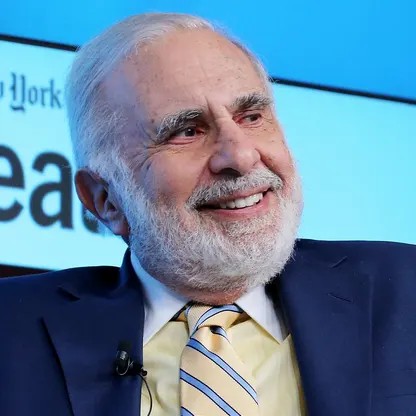
Carl Icahn
Carl Icahn is the founder and controlling shareholder of Icahn Enterprises, and one of the most renowned activist investors in history. Born in 1936 in Queens, New York, he began his career as a stockbroker before founding Icahn & Co. in 1968, building his fortune through risk arbitrage and then pioneering the modern activist playbook: acquiring significant stakes in undervalued, poorly managed companies and aggressively pushing for operational turnarounds, breakups, and management changes to unlock shareholder value. Over five decades, his campaigns — targeting companies from TWA and Texaco to Apple and Netflix — have unlocked billions in shareholder value and earned him a reputation as the most feared and respected corporate raider on Wall Street. His track record is built on a simple, consistent framework: buy deeply undervalued companies when nobody wants them, go in and hold management accountable, and hold for the long term. Icahn frequently notes that his greatest returns came not from quick flips but from holding companies for 7–9 years — ACF Industries for over 30 years, American Railcar for 23. He exited the hedge fund business to operate with permanent capital, arguing that activism requires the ability to buy more when stocks decline rather than being forced to sell into redemptions. His influence extends beyond markets into policy, where he has been an active voice on corporate tax reform and governance, and briefly served as a special advisor to President Donald Trump on regulatory reform. Icahn's career is one of the most durable demonstrations that concentrated, conviction-driven value investing — combined with a willingness to confront management — can compound capital across decades and market cycles.
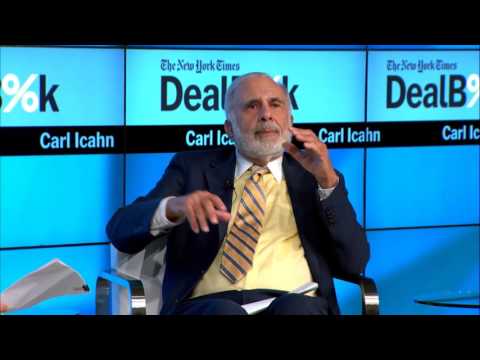
Activists aren't all short-term — the long-term value approach
▶ 5m 3sIcahn rejects the premise that activists contribute to short-term behavior. He reads a list of companies he has held for decades — ACF for 31 years, American Rail Car for 23, Federal Mogul for 17 — and explains that the real money he made came from holding companies for 7–9 years, not flipping them. His framework: buy deeply undervalued companies when everybody hates them, go in and fix management accountability, hold through the turnaround, and sell when everybody wants them. Using the analogy of inheriting a vineyard where the manager plays golf all day, uses company resources for personal benefit, and will not give the owner any money, Icahn argues that Corporate America's fundamental problem is the lack of accountability — and that is where the opportunity lives. The edge is not brilliant stock picking; it is holding management accountable and being patient enough to let the value compound over years.
"The real money that I made over the years is holding companies for seven, eight, nine years and keeping them. You buy things when nobody wants them... and then when everybody wants them, you sell it to them."
The ACF story: nobody knew what 12 floors of people did
▶ 7m 36sIcahn tells the story of his ACF investment 31 years ago — the archetypal example of how he finds value. After buying control of the railcar manufacturer at $30 a share, he went to understand the business and discovered 12 floors of employees in New York whose function nobody could explain. He spent days going floor to floor, brought in Columbia University consultants for $250,000, and even the consultants admitted they did not know what the employees did either. The COO in St. Louis, a former Marine captain, told him bluntly to get rid of all of them — and said Icahn would need 30 fewer support staff once the 12 floors were gone. Icahn fired everyone across all 12 floors, sold the lease for $10 million, and never received a single complaint. The lesson: massive operational bloat hides in plain sight in companies where no one is truly accountable, and the simple act of going in and looking with your own eyes reveals value that no spreadsheet ever will.
"I said, Joe, what the hell does that mean, minus 30? He said: Cause you don't have the balls to do what I'll tell you to do. Get rid of all of them tomorrow."
Two ticking time bombs: overstated earnings and ETF liquidity
▶ 5m 31sIcahn identifies two underappreciated systemic risks in markets. First, companies are systematically overstating earnings — borrowing cheap money to buy back stock, inflating EPS to hit option targets, and using non-GAAP accounting that ignores depreciation, amortization of intangible assets, and goodwill. Valeant is the extreme example of a practice that is widespread: many companies are doing the same thing. He estimates the S&P 500 is really trading at 23× earnings, not the widely cited 17×. Second, ETFs are weapons of mass destruction — the corporate bonds underlying them do not trade, and in a crisis no one will guarantee liquidity. When everyone rushes to sell, who buys those bonds? BlackRock will not. The whole system, he warns, is on a precipice.
"These ETFs are weapons of mass destruction — because what stands behind an ETF are bonds that don't trade. Who the hell's going to buy those bonds? Is Larry Fink going to buy them? BlackRock's not going to buy them."
Why I left the hedge fund business: permanent capital
▶ 3m 36sIcahn explains the structural reason he exited the hedge fund business: activism and non-permanent capital do not mix. When outside investors can redeem, you are forced to sell at exactly the wrong moment — during drawdowns. In 2008, when everyone wanted their money back, he bought out all his investors for roughly $1.5 billion — one of the best buys he ever made. Now, with permanent capital, he actively wants his positions to go down so he can buy more. He is currently losing money on energy positions like Transocean and Chesapeake, but he is waiting to add. The conventional wisdom says you should fear drawdowns; Icahn's counterintuitive framework is that permanent capital plus conviction transforms a falling stock from a threat into an opportunity, enabling the kind of compounding that hedge fund structures structurally prevent.
"I don't really mind them going down because I know in my mind that I'm going to buy more of them. I've done that all my life. When these companies go down, I have the money and the buying power to do it."
Fixing repatriation: the simple law Washington can't pass
▶ 4m 15sAsked if he would be Trump's Treasury Secretary, Icahn declines and pivots to a concrete policy problem: corporate inversions. Companies like Pfizer are moving overseas because the US tax code traps foreign earnings abroad. The fix is straightforward — pass a repatriation law that lets companies bring cash back at a reasonable rate. Everyone in Washington agrees it should happen: Paul Ryan wants it, Chuck Schumer wants it, every member of the Ways and Means and Finance Committees he has spoken with wants it. But the left wing says do not forgive those taxes and the right wing says charge zero — and the gridlock means more companies leave every month. Icahn has been on the phone for weeks lobbying for this. The broader point: Washington gridlock has real economic consequences that most investors underestimate, and simple fixes remain undone because both sides are dug in.
"These two sides are so dug in against each other... it's almost like a fantasy world, Alice in Wonderland. And companies like Pfizer are going to leave as we sit here."
Trump, super PACs, and shaking up the system
▶ 2m 40sIcahn endorses Donald Trump as the candidate who can break the partisan gridlock, dismissing the view that his candidacy was not serious. On his $150 million super PAC, Icahn defends the practice: disclosure is what matters, and there is nothing wrong with spending money to press your point in Washington. He suggests the US should adopt a UK-style system where the government funds campaigns so politicians do not have to spend their time raising money from donors. The thread connecting it all: Icahn believes the system is broken at a structural level — both in politics and in corporate boardrooms — and that the standard playbook needs to be challenged from outside by people willing to be unpopular.
AIG breakup and the Lyft vs Uber arbitrage
▶ 3m 40sIn the Q&A portion, Icahn explains two of his current investments. On AIG: the breakup case is self-evident — the conglomerate structure destroys value, and when something is that obvious, he can get an audience with management. He is waiting to hear what CEO Peter Hancock has to say, keeping an open mind. On Lyft: he invested $100 million because it is completely absurd that Uber sells for $55 billion and Lyft sells for $2 billion — two companies in the same business with a 27× valuation gap. If he could, he would short Uber and go long Lyft as a pure valuation arbitrage. The Lyft bet embodies Icahn's core framework: identify extreme valuation dislocations where the market has become unmoored from fundamentals and position against the consensus before the gap closes.
"It's completely absurd that Uber sells for 55 billion and Lyft sells for 2 billion. If somebody was willing to pay 55 billion in the old days, I would short that and buy Lyft."
Short disclosure and the real earnings problem, revisited
▶ 2m 40sAsked about requiring hedge funds to disclose short positions, Icahn believes in disclosure in principle but has not thought deeply about the mechanics. The more substantive exchange comes when asked about Valeant's ethics — specifically buying drugs and raising prices 5,000%. Icahn clarifies: his critique of Valeant was never about ethics; it was about accounting. Many companies are overstating earnings by refusing to amortize intangible assets from acquisitions. The market is pricing in earnings that are not real. His warning from earlier in the conversation is reinforced: the earnings many of them are overstated, and the S&P 500 is really going to 23 times earnings, not 17.
Why index funds can't be activists — and advice for the next generation
▶ 4m 43sIcahn dismisses Larry Fink's claim that BlackRock engages privately with portfolio companies. The conflict is structural: companies give BlackRock their 401(k) business, so why would BlackRock vote against management? He has never seen them vote for his proposals. To a student asking about breaking into the industry, Icahn offers a sober warning: the public will become disillusioned in the coming years as bubbles in high-yield bonds burst and the too-big-to-fail safety net is gone. But for those willing to take genuine risk, the capitalist system still rewards it enormously — hedge fund managers take no personal risk yet get paid millions. He ends with his Apple thesis: his son introduced him to it, and he bought at 8–9× earnings, making it a classic Graham and Dodd value play despite being a tech company. The real skill is not picking stocks — it is finding companies you understand, nurturing them, and having the patience to let value compound.
"If you want to make a lot of money, take risks — that's what a capitalistic system is about. But don't get paid all this money for managing money. I'd like you to show me somebody that really knows how to pick stocks. I never met anybody that can."