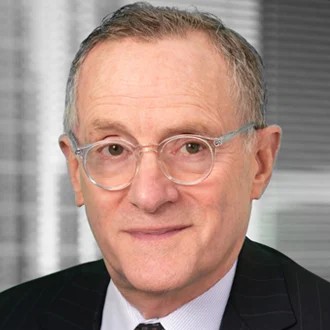
Howard Marks
Howard Marks is the co-founder and co-chairman of Oaktree Capital Management, one of the world's largest distressed debt and alternative investment firms with approximately $180 billion under management. His investment memos — written over three decades and read widely by investors including Warren Buffett — distill his philosophy on risk, market cycles, contrarianism, and the limits of forecasting into clear, accessible prose. Marks is a value and distressed debt investor at his core, but his thinking on risk is what sets him apart: he argues that superior investing is not about making the most money in good times, but about controlling risk so you survive — and profit from — the bad times. His framework rests on six core principles: risk control as job one, consistency over boom-and-bust, targeting less efficient markets, deep specialization, and no reliance on macro forecasting or market timing. A Wharton graduate who discovered finance after falling in love with accounting, Marks has been a trustee of the Metropolitan Museum of Art and the University of Pennsylvania, and remains one of the most influential voices in institutional investing.
Books
Distills the core investment philosophy that has guided Oaktree's success for decades. Marks explains the importance of second-level thinking, the nature of risk, and why understanding market cycles matters more than forecasting. Each chapter unpacks one 'most important thing' — from recognizing that price is different from value to knowing what you don't know — delivering a framework that is as much about clear thinking as it is about investing.
A deep examination of the cyclical forces that drive markets, economies, and investor psychology. Marks explains why cycles exist, how to recognize where you are in them, and — critically — when to act on that knowledge. Rooted in decades of experience navigating boom and bust in credit markets, the book gives investors a practical framework for positioning rather than predicting.
Videos

How he discovered finance through accounting
▶ 1m 14sA single accounting course in a crowded New York public school was all it took — the symmetry of debits and credits clicked with his left-brained, logical mind. He went to Wharton intending to become an accountant, was introduced to finance as a far more interesting field, and switched. The accounting foundation gave him a framework for thinking about business that shaped his entire career.
"Not many people love accounting. But it has a symmetry that a certain kind of mind responds to."
The six tenets of Oaktree’s investment philosophy
▶ 1m 14sMarks lays out the six principles that govern every Oaktree investment decision: risk control as job one, consistency over boom-and-bust returns, targeting only the less efficient markets, deep specialization (knowing more than everybody else about a few things), no reliance on macro forecasting to drive investments, and no expectation from market timing. The framework is built around a single insight — it is easy to make money in the good years, but the real skill is making money with risk under control so that in the bad years you don’t give it all back.
"I believe it’s easy to make money in the market. The real skill is to make money with the risk under control so that if it turns out to be a bad year instead, you won’t do too badly."
Why macro forecasters don’t present a track record
▶ 1m 53sHis adherence to the six tenets has grown stronger over 50 years because the longer he lives, the more deeply he understands the limits of human knowledge. Macro forecasters and economists are not right consistently enough to follow — and he points out that no economist ever presents a track record, because if they did they wouldn’t be hired. An old Wall Street joke: an economist is a portfolio manager who never marks the market. Active investors would never hire someone without looking at their record, but economists don’t have to show one.
"No economist ever presents his record. They can’t, because they wouldn’t be hired."
Randomness, luck, and what age teaches about patience
▶ 3m 14sRandomness governs everything in markets because markets are made of people, and people have feelings — Feynman observed that physics would be much harder if electrons had emotions. The most important lesson from his first Wharton textbook: you cannot judge the quality of a decision from its outcome. The ingredients of success are aggressiveness, timing, and skill — and if you have enough aggressiveness at the right time, you don’t need much skill, which is why stupid people sometimes get rich. But to be right repeatedly over an entire career requires genuine skill. Age helps: it mellows you, teaches you that quick action is rarely the answer, and gives you the patience to think before acting.
"You can’t tell the quality of a decision from the outcome. In the short run, randomness alone can produce just about any outcome."
Why markets move in cycles — and always will
▶ 2m 48sMarkets and economies move cyclically because human behavior goes to excess. When the economy grows well, every business builds new factories to capture market share — but so does everyone else, creating overcapacity that triggers a downturn, which then causes underinvestment and sets up the next recovery. Greed and fear, optimism and pessimism, credulousness and skepticism form a perpetual pendulum. The biggest mistake investors make is believing that whatever is currently happening will continue forever. In truth, regression toward the mean is far more dependable than extrapolation.
"Regression toward the mean, or the correction of excesses, is much more dependable than continued moving in a straight line."
You can only forecast at extremes — five times in 50 years
▶ 2m 25sWhen asked whether it’s contradictory to dismiss forecasting yet believe in reading cycles, Marks draws a critical distinction: forecasting becomes useful only at extremes — crazy highs or crazy lows — because that’s when regression toward the mean is dependable. His son once pointed out that he has only made such forecasts five times in 50 years. Knowing where we are in the cycle is different from predicting what will happen next or when it will happen. Right now, he believes the market is in the middle ground — a bit above fair value but not at an extreme where a decline is predictable.
"When the market is crazy high or crazy low, I think we can make a profitable forecast. The only thing is we don’t get too many opportunities — I’ve done it five times in 50 years."
The market is 20% overvalued — and that doesn’t tell you much
▶ 3m 5sThe S&P 500 at 21× earnings versus a post-war norm of 16× suggests roughly 20–25% overvaluation. But that doesn’t mean a decline is imminent — overvalued markets can become more overvalued, then more overvalued, and then reach a genuine bubble. If every overvalued market corrected immediately, bubbles would never form. His colleague at Oaktree has a useful rule: if you name a price, don’t name a date; if you name a date, don’t name a price — then you can never be wrong. The probability of a decline in the next year is only modestly above 50/50, even if you’re correct about overvaluation.
"If it was true that every time the market’s overvalued it corrects, then you wouldn’t get bubbles."
Risk management is not risk avoidance
▶ 1m 4sSound risk management is not about avoiding risk — risk avoidance usually results in return avoidance. If you want to make a good return, you have to take risk, but you should not expect to make money just for taking risk; you have to do it skillfully. The process he calls the intelligent bearing of risk for profit requires four conditions: it must be risk you are aware of, risk you can analyze, risk you can diversify, and risk you are highly paid to take. The Oaktree motto, born from their fixed-income origins: if we avoid the losers, the winners take care of themselves.
"If you want to make money, you have to take risk. But you should not expect to make money just for taking risk — you have to do it skillfully."
Certainty is the enemy: probabilistic thinking in investing
▶ 2m 49sBecause investing deals with people, not physical laws, there is always a range of possible outcomes. Elroy Dimson defined risk perfectly: “risk means more things can happen than will happen.” Mark Twain captured the danger of certainty: “it ain’t what you don’t know that gets you into trouble, it’s what you know for certain that just ain’t true.” Marks cites the December consensus that the Fed would cut rates six times in 2024 as a clear example — the Fed’s own dot plot said three, yet the market doubled it out of Goldilocks optimism. The market’s muted reaction to that error shows that optimists still hold sway.
"Risk means more things can happen than will happen. And it ain’t what you don’t know that gets you into trouble, it’s what you know for certain that just ain’t true."
Risk control belongs to every investor, not a separate department
▶ 3m 59sMarks has always resisted having a separate risk management department. His reasoning: when there is a person in the corner whose job is to think about risk, everyone else stops thinking about it — dangerous territory. If the portfolio manager thinks solely about upside and delegates risk to someone else, the investor mentally checks out of the most important part of the job. Risk control is everybody’s responsibility at Oaktree, which is why it sits as tenet number one of the investment philosophy. Every analyst and portfolio manager must be thinking about risk, not counting on someone else to limit it.
"When there’s somebody over in the corner whose job is to think about the risk, everybody else says “well I can count on somebody else to limit the risk.” I think that’s dangerous territory."
What poker, bridge, and backgammon teach about investing
▶ 2m 20sCard games and chess are deeply instructive for investors because they are all probabilistic — nothing you do will always work, both because luck is involved and because you are playing against a skillful opponent. The key skills are the same: assessing probabilities, structuring your bet size, and knowing when you have an advantage and when you don’t. Financial markets are a gamble — not in a dismissive sense, but in the fundamental sense that you are putting up money in the hope of getting more back, knowing you could lose your stake. Marks has spent his entire career in market niches considered risky, which forced him to develop the intelligent bearing of risk for profit as a consistent discipline.
"There’s almost nothing you can do that will always work — in part because luck is involved, and in part because you’re playing against an opponent who is skillful."
Annie Duke, thinking in bets, and the contrarian payoff
▶ 2m 55sAnnie Duke, the former world champion poker player who earned a PhD in decision analysis, wrote a book called Thinking in Bets that Marks considers essential. The core idea: we can reduce our analytical process to structuring things as bets. The key insight comes from sports betting — it is not just about which outcome is more likely, but whether the payoff for betting on the less likely outcome is so high that it becomes compelling. That is exactly how markets work, and it is the bridge to contrarian investing. Marks published a memo in January 2020 titled ‘You Bet!’ about Duke’s approach, and the framework has shaped his thinking ever since.
"It’s not what outcome is likely to happen, but is the payoff better for investing in the team that will probably lose? Even the improbability of their success is overcome by the fact that you’re offered sufficient odds."
Consensus is already in the price — being contrarian is essential
▶ 2m 12sThe consensus on every subject is already embodied in every asset’s price. You don’t usually make much money by betting on what everybody else loves. The big money is made betting on the things they hate — which, as a result, are cheap, if you’re right. But Marks is careful: contrarianism is not simply doing the opposite of the crowd. The real process is deeper: you must understand what the consensus thinks, what you think, where the consensus is wrong, why they think that way, and what could expose the error. That is a high bar, and it means you cannot be contrarian routinely — only when the analysis justifies it.
"The big money is made by betting on the things they hate, which as a result are cheap — if you’re right."
Dare to be great: you have to be a loner to be exceptional
▶ 1m 26sIn his 2015 memo Dare to Be Great, Marks laid out three requirements for exceptional investing. First, you have to dare to be different — your portfolio must differ from the crowd or you cannot distinguish yourself. Second, you have to dare to be wrong — you must take on unpopular positions, which means accepting the real possibility of being incorrect. Third, and hardest, you have to dare to look wrong — even if you are right, it will not be clear for some time, and in that period you will look out of step, be criticized, and feel inadequate. You have to be comfortable existing outside the mainstream, which is fundamentally a loner’s disposition.
"If you want to be an exceptional investor you have to dare to be different, dare to be wrong, and dare to look wrong — because even if you’re right, it’s probably not going to be clear for some time."
Surviving being wrong: the partner who makes it possible
▶ 2m 9sHow does Howard Marks handle the periods of looking wrong? He credits two things. First, a quirk of personality — he has always been something of a loner and believes deeply in the power of the brain to reason through uncertainty. Second, and more importantly, his partner Bruce Karsh. Together they bought $650 million a week for 15 weeks following the Lehman Brothers bankruptcy — $10 billion total — supporting each other through decisions that felt terrifying at the time. When you have a partner you respect who supports you, what would be individually impossible becomes feasible. After doing this successfully a few times, you develop a kind of muscle memory — you recognize the feeling and say to yourself, “oh yeah, this is one of those.” Having been proven right in the past builds a deep respect for your own process.
"When you have somebody you respect who supports you, things that would be difficult individually become easier. After you do it a few times, you develop a feeling — oh yeah, this is one of those."
Taking the market’s temperature
▶ 2m 28sMarks describes his method for gauging market psychology as qualitative, not quantitative: he looks at what opinions are being expressed, how uniformly and strongly they are held, and how self-satisfied the people holding them appear. During bubbles, the people making the most money are doing it for the silliest reasons — their justifications don’t hold up to scrutiny. The current reading is moderate, and the widespread uncertainty he observes is actually healthy. Returning to Mark Twain’s wisdom, being uncertain is the natural and correct state for an investor — when you are certain, that is when you are in danger.
"I spend a lot of time trying to take the temperature of the market and get a sense for whether other people are operating out of extreme optimism or extreme pessimism. Right now, it’s moderate — and uncertainty is healthy."
The illusion of knowledge and the power of observation
▶ 3m 8sEverybody has access to the same data and knows what happened yesterday — the edge is in figuring out what it means. Marks describes himself as an observer rather than a data gatherer: he reads two or three newspapers a day and The Economist, but the most important work is sitting and thinking about the implications of what is happening. He sensed the 2008 financial crisis coming not because he understood subprime mortgages — he didn’t even know they existed — but because he observed that markets were behaving in a carefree, non-risk-conscious manner, which is always the most dangerous condition. The historian Daniel Boorstin said it best: the enemy of knowledge is not ignorance, it is the illusion of knowledge.
"The most important thing is not to have the data — everybody has the data. The most important thing is to sit and say: what does it mean?"
If you have to be right all the time, don’t become an investor
▶ 1m 43sHis most important advice to young people considering a career in finance: understand that you cannot be right all the time. Taleb contrasted investing with dentistry — a dentist who learns to fill a cavity correctly will succeed every time, but there is nothing in investing where you can be right every time. If you are right 60% or 70% of the time, you will be among the smartest people in the world. Investing is a great intellectual puzzle with many layers to peel back like an onion, but you have to equip yourself philosophically for the ups and downs of being wrong. And you need an apprenticeship — learning from somebody else who knows how to do it.
"If you’re the kind of person who has to be right all the time, don’t become an investor. If you’re right 60% or 70% of the time, you’ll be the smartest man in the world."
Investment philosophy is personal
▶ 4m 41sThe book "The Most Important Thing" came from Marks repeatedly telling clients different things were "the most important thing." Real investment philosophy isn't adopted from a book or a teacher—it emerges from the collision of what you're taught and what lived experience tells you about those lessons. No formulas work in investing; the goal is to teach people how to think, not what to think.
"I wasn't born with an investment philosophy... Your philosophy will come from the combination of what you have been taught by your teachers and parents and your experiences and what your experiences tell you about the things you were taught."
Fooled by Randomness
▶ 3m 34sTaleb's "Fooled by Randomness" taught Marks that randomness pervades investing. In physics, a good design reliably produces a working bridge; in investing, a good decision can fail and a bad decision can work purely because of luck. The investment business is full of people who were "right for the wrong reason"—bailed out by events despite a flawed process. You cannot judge a decision by its outcome.
"The investment business is full of people who are, quote, right for the wrong reason. Made a bad decision, it didn't work out the way they thought, but they got lucky."
Risk means more things can happen than will happen
▶ 4m 35sEven if you know the most likely outcome, many other things can happen instead. The highest expected value course of action may include outcomes you absolutely cannot withstand—and you shouldn't take it. You must survive the bad days, not just the average ones. The six-foot man drowned crossing a stream that was five feet deep on average.
"Risk means more things can happen than will happen."
Why conventional forecasting makes no money
▶ 3m 13sGalbraith said there are two classes of forecasters: those who don't know and those who don't know they don't know. Most forecasts are extrapolations—predicting the future will look like the recent past. These extrapolation forecasts are often right but never profitable, because the consensus is already priced into securities. Being right about the obvious earns nothing.
"Usually, the people who forecast a continuation of the current are right. The only problem is they don't make any money."
The trap of deviant forecasts
▶ 3m 4sThe forecasts that make money are those of radical change—predicting minus-2 when everyone expects 2.4. But deviant forecasts are almost impossible to make correctly on a consistent basis. The forecaster who nailed one radical call was making radical calls every time and was wrong every other time. Forecasting has no value unless someone is right consistently—and nobody is.
"The forecasts that make money are the forecasts of radical change... Of course, they do not have any value if they're incorrect."
Investing is a loser's game
▶ 4m 49sCharlie Ellis's analogy: championship tennis is a winner's game, won by hitting winners; amateur tennis is a loser's game, won by avoiding errors. In investing, randomness means even doing everything right doesn't guarantee a winner. Most investors should emphasize avoiding losers rather than pursuing winners. Marks agrees but adds nuance: winners can be pursued, but only by genuinely exceptional investors.
"The amateur tennis player wins not by hitting winners but by avoiding hitting losers... The best way to win at investing is by not hitting losers."
The Milken meeting: why single-B bonds win
▶ 2m 1sIn November 1978, Marks met Mike Milken, who explained a simple asymmetry that shaped his career. If you buy AAA bonds—perfect companies with perfect outlooks—the only possible surprise is negative. Perfection can only deteriorate. But if you buy single-B bonds that survive, the surprises are on the upside because expectations are already so low. Low expectations are a margin of safety.
"If everything's perfect, that means it can't get better. And if it can't get better, that means it can only get worse."
It's not what you buy, it's what you pay
▶ 4m 53sThe secret to investing is not buying good assets—it's buying things for less than they're worth. The Nifty Fifty were America's greatest companies, but buying them at 80-90x earnings in 1968 lost 90% by 1973. Meanwhile, investing in the "worst" companies through high-yield bonds made the most money—because the price was right. But the key three words in Milken's pitch were: "and they survive."
"What determines the success of an investor is not what he buys but what he pays for it."
Bond investing is a negative art
▶ 3m 21sGraham and Dodd's 1940 "Security Analysis" called bond investing a "negative art." All bonds that pay, pay the same 5%—it doesn't matter which ones you pick among the survivors. The only thing that matters is excluding the ones that default. Your greatness as a bond investor comes not from what you buy but from what you successfully exclude from the portfolio.
"The greatness of your performance comes not from what you buy but from what you exclude."
Oaktree's philosophy: risk control, consistency, and lopping off the left tail
▶ 5m 17sMarks distills his four origins into Oaktree's six tenets: risk control above all else, consistency over boom-and-bust returns, no reliance on macro forecasting, and no market timing. The guiding model: if we avoid the losers, the winners take care of themselves. Instead of aiming for the top quartile and risking the bottom, they lop off the left-hand tail—and the consistency math is extraordinary. A fund never above the 47th percentile or below the 27th for 14 years ended up in the 4th percentile, because other funds blow up.
"I have no interest in being in the bottom 5%. And I don't care about being in the top 5%. I want to be above the middle on a consistent basis over the long term."
Three adages—and why prudence is counter-cyclical
▶ 3m 59sMarks closes his prepared talk with three timeless adages. First: what the wise man does in the beginning, the fool does in the end—every trend eventually becomes overdone. Second: never forget the six-foot man who drowned in a stream five feet deep on average—you must survive the bad days. Third: being too far ahead of your time is indistinguishable from being wrong. A Q&A follows: if everyone became prudent, would contrarianism flip? Marks answers that most people want to get rich, not be prudent. Prudence only takes over in crashes—exactly when you should turn aggressive.
"Being too far ahead of your time is indistinguishable from being wrong."
Superior judgment and second-level thinking
▶ 2m 16sAsked about macro forecasts, Marks explains you need an economic framework but the real question is how radical your assumptions are. None of this works without superior judgment. The first chapter of his book says the most important thing is second-level thinking—thinking differently from everybody else, and better. The first-level thinker says "great company, buy." The second-level thinker says "great company, but not as great as everyone thinks—sell."
"To be a superior investor, you must think on the second level. You have to think different from everybody else. But in being different, you have to be better."
Index funds don't eliminate risk, just benchmark deviation risk
▶ 2m 20sIndex funds guarantee you match the index—they don't eliminate risk. They eliminate the risk of deviating from the benchmark, but when the index goes down, the index fund investor loses money with no value-added buffer. Index investing is a fine choice for amateurs who can't beat the market, but it is not a riskless trade.
"The index fund investor loses money every time the index goes down. Why? Because there's no value added to keep it above."
Why markets stay inefficient enough
▶ 2m 1sMost investors can't beat the market because the market is efficient—prices are kept roughly right by thousands of active investors hunting bargains. But here's the paradox: when too many give up and switch to passive, prices resume deviating from intrinsic value and beating the market becomes possible again. Active management sows the seeds of its own revival.
"When the interest in active investment declines because people give up on it and turn to passive investing... then prices resume their deviation from intrinsic value. Then it becomes possible to beat the market again."
Catalysts and the fixed-income advantage
▶ 2m 18sYou can never estimate how long it takes for price to converge to value—which is exactly why being too far ahead of your time feels identical to being wrong. Fixed income investing has a structural advantage: a bond's maturity date is a guaranteed catalyst that forces convergence. Most equities have no such catalyst—an undervalued stock may stay undervalued indefinitely.
"There's no way to estimate the time... and that's the reason why being too far ahead of your time is indistinguishable from being wrong."
Raising money for what nobody wants to buy
▶ 3m 54sIn 1978, 90% of institutions had explicit rules against high-yield bond investing. The pitch to early clients: "You should do this because nobody else is." You make money doing what nobody wants to do that turns out to have value. Oaktree's distressed debt strategy exemplifies this—buying the debt of bankrupt companies for less than it's worth has returned approximately 23% annually for 28 years, before fees and without leverage.
"You make no money doing the things that everybody wants to do. You make money by doing the things that nobody wants to do who then turn out to have value."
The small investor's edge—and the capacity trap
▶ 3m 33sBuffett once said he could guarantee 50% annual returns running small sums. The small investor has a genuine edge—as long as they're willing to stay small. But success brings more money, more money degrades performance, and the fees from managing more assets create a powerful incentive to let the process become unchecked. You cannot do destructive testing with client capital—you must stop before you hit the wall.
"The person who has a big brain, and a little money, and a lot of time, and exceptional insight can find great bargains. But that's a pretty daunting list."
The race to the bottom
▶ 5m 12sWith the risk-free rate near zero, safe instruments pay no income. Investors are chasing yield mindlessly—seduced by 6% versus zero, with no understanding of the risks they are taking. The result is a reverse auction: lenders bid down yields and waive protective covenants, issuing bonds at 5% with no protections. When people do risky things, the market becomes a risky place. Oaktree's posture: move forward, but with caution.
"When people are, number one, eager to invest and, number two, not sufficiently risk conscious, they do risky things. And when people do risky things, the market becomes a risky place."