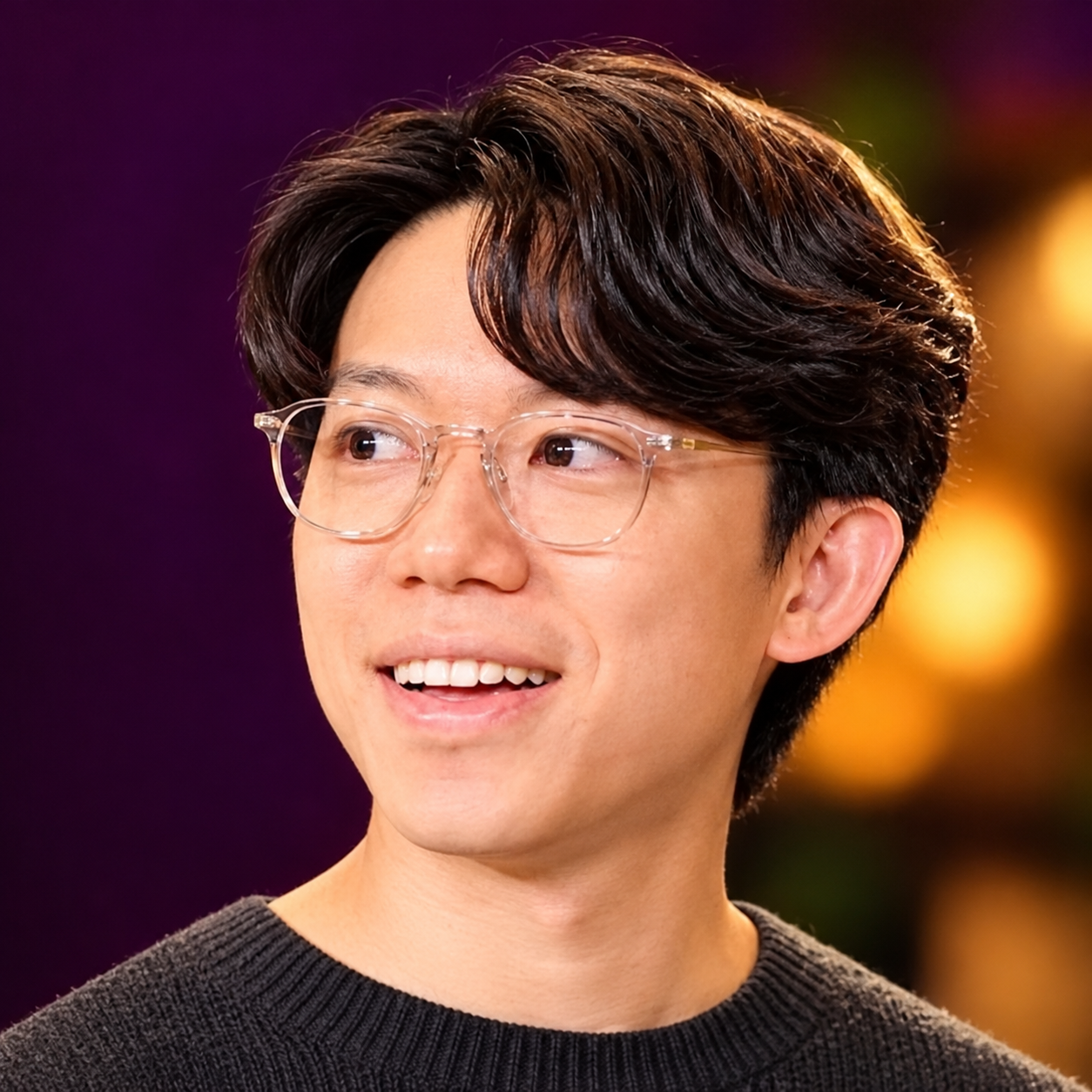
J Law
Law Wai-Sum, known as J Law, is a Hong Kong-based trader and former secondary-school teacher who won the U.S. Investing Championship's $1 million verified division in 2024 with a 353.9% return — the first Hong Kong winner, surpassing Mark Minervini's 2021 record. He defended the title in 2025 with a 252.3% return, becoming the first Asia-based trader to win back-to-back titles in the top division, for a two-year cumulative return of 1,499%. A self-taught trend and momentum trader, he combines swing and position trading with a theme-based approach and uses AI tools to research catalysts. He has since begun expanding his trading-education business, JLawStock, internationally.

Luck, Market Conditions, and a System of Your Own
▶ 2m 16sJ Law credits part of his back-to-back titles to luck and uncontrollable conditions — the strong 2024–25 bull market and the fast 2025 recovery — but argues that luck only pays off if he already has a system with proven positive expectancy. Self-taught, he says the legends' books are a foundation, not a method: you have to combine what you learn with your own personality, strengths, and advantages.
"You need to look at your own individual personality, your personal strengths and the advantages that you have and then you take what you have read in books or what other people have taught you and combine all of these things together to develop your own personal method."
From Day Trader to Position Trader
▶ 2m 22sJ Law began as a short-term day trader and moved to higher-timeframe position and swing trading after starting a family. He explains that every style has its own logic, strengths, and failure conditions: short-term trading demands a sharp read of price action — breakout versus pullback, sometimes trading against textbook technical analysis — while longer holding periods require understanding the macro, the industry, and the company. In his experience technical analysis handles about 70% of decisions; the remaining 30% needs fundamentals.
"Technical analysis is useful 70% of the time, and for the other 30% of the time you are going to need to combine it with fundamental analysis."
What Carries Over — and Turning Fundamentals Into Themes
▶ 2m 43sAnswering whether the two styles conflict, J Law says they complement each other and that even an O'Neil-style weekly-chart trader still needs the technical basics. His own "fundamentals" are thematic rather than accounting-based: he studies the narrative, the themes, and the underlying logic behind a move, not financial statements or corporate reports. The technique is the same at every timeframe; only the holding period changes.
"For me, understanding the fundamentals does not mean analyzing financial statements or going deep into corporate reports. Instead of that, I lean toward a more thematic approach, which is basically what I refer to as a theme-based trading style."
History Rhymes: Winners Share a Market Feel
▶ 3m 10sJ Law compares February 2026 — energy, materials, and gold strong while tech struggled — with the 2022 Russia–Ukraine period that lifted fertilizer, energy, and alternative-energy names. He argues that big winners share a common market feel, and that studying a winner in isolation misses the point: you have to compare it with the market and with its peers to understand why it became the leader under those specific conditions.
"Only when you learn to put stocks into context can you understand why a particular stock emerges as the market leader under specific market conditions."
A Bad Student Who Learned How to Learn
▶ 2m 7sJ Law became a teacher because he had been a bad student in Hong Kong, and the job taught him how to learn and how to study for exams. He applied that meta-skill to trading after several unprofitable years: he stopped reading random material and began studying his own mistakes. Reviewing trades from his own account — more than 1,000 of them — showed the same errors repeating over and over.
"I discovered that the most efficient way to improve was to study my very own mistakes and see exactly how I went wrong."
The Two Mistakes — and the Rules That Catch Them
▶ 3mThe two recurring errors were drawdowns that grew too large because risk was uncontrolled, and emotional trading — revenge trading and trying to win money back quickly. Consistency did not arrive overnight: mistakes still happen, but awareness now catches them earlier. He writes every mistake into a growing checklist of rules, adds to it each year, and cutting his error rate from 80% down through 40%, 30%, and 20% dramatically improved performance. When mistakes cluster, his first step is to reduce trading frequency and screen time.
"So what I do is actually write down every single one of these mistakes and I keep a constant record of them in order to make it a key part of my overall process."
One or Two Windows a Year — Keep 50% Cash
▶ 5m 33sThe periods when J Law trades aggressively are rare — one or two a year. Most of the time he holds at least 50% cash, which limits drawdown and always leaves him a way out. He walks through the 2015 sideways market that broke into an August selloff, the two 2016 windows in February and after Donald Trump's election, and 2017's resemblance to 2024; he also notes that April–July 2025 alone was enough for a large annual return, while staying aggressive through Hong Kong's 2015 reversal gave back April–May gains. Doing nothing is not the plan — he manages exposure and position size and knows when to go all-in.
"Actually, the periods of time when you should be trading aggressively are quite rare."
Diagnose the Drawdown, Then Demand 4–5x
▶ 2m 41sWhen a drawdown appears, J Law first diagnoses its cause. If it comes from emotional or technical weakness, he stops and relearns — otherwise he risks losing everything. If it is a normal market correction and his positions were not stopped out, he controls his emotions and waits, because most of his money is made after corrections. A technically good trade offers at least four to five times his risk to the next obvious resistance; at that ratio he can be wrong most of the time and still make money.
"Even if I'm wrong 80% of the time, mathematically I can still make money and not lose any."
Competition Aggression vs Personal Risk
▶ 5m 20sThe competition account is deliberately more aggressive because the goal is return, and three-digit returns require large size — which means volatility. His personal trading is far less aggressive. Even when pressing, he caps the maximum drawdown the whole account could suffer: in March 2025 he made roughly 10% on the short side and treated that profit as the risk budget for April, willing to give all of it back for a massive setup. Position size is calculated from the maximum drawdown a single trade could bring to the account, not from conviction.
"I calculate the size of my position based upon the maximum drawdown that a single individual trade could bring to the account."
The 0.5% Per-Trade Risk Framework
▶ 1m 13sA worked example: with the account up 10% and a maximum of 0.5% risk per trade, a 5% technical stop allows a 10% position. Ten such trades put him 100% invested, and even if all ten are stopped out the account takes only a 5% drawdown — half the gains returned, 5% profit retained. If the market turns out not to be at the real bottom, he still has profit and risk budget left for the actual pivot.
"Even if all 10 trades happen to get stopped out, my account only takes a 5% drawdown."
No Average Month: Trade When the Window Opens
▶ 2m 19sJ Law has no average number of trades per month; activity follows opportunity. After the strong 2023–25 run, the first quarter of 2026 was a whipsaw with few setups and he traded much less — roughly 200 trades across all of 2025. In poor conditions he still takes smaller trades, but only with a clear theme; energy has been a recent focus, though its cyclical nature makes it harder to size for a big move.
"If the necessary conditions are not there, I will barely be trading at all."
Buy First, Research Later
▶ 1m 41sMarkets price events before headlines do, so sectors often move before the news explains why — and J Law frequently buys without knowing the reason. He buys first and researches afterward, using AI to make that research fast enough to judge whether the reason is real. If it holds, he builds the conviction to hold or add.
"I tend to take the approach of buying first and then doing my own research later on."
Two AIs, Cross-Examined
▶ 4m 18sHis AI process starts from momentum: he only asks why once a stock is moving. He asks one model why, feeds that answer to a second model to check the logic, asks the second what the first missed, then feeds the critique back to the first — producing a fuller picture of the catalyst and related news. He also asks AI to explain the company simply, borrowing Jensen Huang's instruction to explain it as if to an 18-year-old. Gemini handles deep analysis, Grok real-time X-backed information, and ChatGPT general work.
"If you ask it good questions, you are going to get back good answers. But if you ask it garbage, you are going to get back garbage."
AI by Timeframe: Essential for Swing and Position Traders
▶ 3m 12sJ Law started using AI in 2024 and found it became a real assistant in the third and fourth quarters of 2025. Its value depends on timeframe: pure day traders do not need it, but hybrid and position traders — even two-week swing traders — benefit, because understanding the driver gives the conviction to hold. Many stocks gap up on earnings or news and never look back; a genuine fundamental change can skip the classic pattern and climb at 45°, so deeper knowledge opens entries that chart-reading alone would miss.
"If you do not really understand what is actually driving the financial market, making the correct trading decisions become so much more difficult and you will certainly lack the conviction to hold on to your open positions."
Why He Rarely Shorts
▶ 2m 24sThe vast majority of J Law's trades are long. He shorts only rarely, as a short-term way to capture downside and build a profit cushion — which lowers the psychological pressure and makes execution more decisive in corrections. Past losses on the short side still scare him, and the asymmetry is decisive: a long can theoretically return unlimited amounts while a short is capped at double digits. The hardest problem is bias — flipping from short back to long is difficult, and he has missed big rallies because of it.
"The vast majority of my trades are on the long side. I only take short positions when relatively rare opportunities present themselves and even then I don't short very often."
Correlation, Multiple Accounts, and Why Cash Matters
▶ 3m 13sHis 2024–25 competition runs were theme-driven and focused, but he does not compete every year and does not always trade that way. Personally he keeps more than 50% of his assets in cash and splits accounts by risk mandate — lower-risk swing, aggressive theme-driven swing, position trading, and index ETFs. Small accounts need theme concentration to grow quickly; at a certain size the question becomes whether that risk is still necessary, and cash buys peace of mind.
"Personally, I prefer to make use of asset allocation in order to diversify my risk."
Losing It All, Then Four Lucky Years
▶ 2m 16sJ Law started small and lost all his trading capital, and at times 80–90% of his balance, several times before a lucky break in 2017. He survived a weak 2018, caught the rhythm in 2019 and at the 2020 pandemic low, and four lucky years grew the account. He warns that trading the same way as size grows means one unlucky year can give back a large portion — once risk has taken you to a level, you have to start reducing it.
"Once you take a risk to a certain point, you are going to need to start reducing your risk."
Write Down Your Weaknesses, Rule Around Them
▶ 2m 19sReviewing your past trades shows you who you are. The first lines of J Law's rules describe him as a very emotional person — a permanent reminder. He summarizes each weakness, writes it down, and accepts it, because these weaknesses can never be permanently removed; instead he builds rules that compensate, such as no trading in the first 15 minutes and taking partial profits at a 20% gain, so the weakness cannot be magnified.
"These human weaknesses can never be permanently removed."
Passion, an Open Mind, and Knowing When to Stop
▶ 3m 40sJ Law will not compete again — he says he is retiring undefeated. His advice to competitors is to enjoy it and have genuine passion, because no one performs at their best all the time and everyone has difficult phases. The deeper point is to keep growing and stay open-minded: a method can stop working, so you have to keep refining and upgrading your skills while remaining open to other styles — understanding why they work without copying them.
"The truth is that they can stop working. You really do need to keep a very open mind and maintain a strong mindset of constantly refining and improving your own techniques while always upgrading your personal skills."