
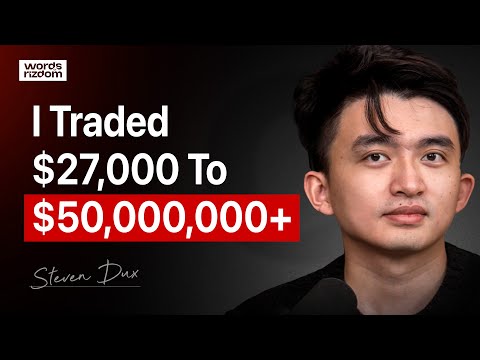
Steven Dux
Chinese-born independent trader who turned $27,000 into over $50 million primarily through short selling small-cap stocks. He learned to trade within 6 months at age 22 and holds the record for the highest single-day P&L in 2022 at over $6 million. Dux's methodology is built on a psychology-first approach to strategy design — understanding what the majority of traders are thinking and positioning against it — combined with rigorous statistical backtesting that narrows entry and exit criteria down to the decimal point. His framework filters for stocks meeting five precise criteria (percentage gain, pre-market volume, price, market cap, and float) and exploits the point at which retail buying power exhausts itself, creating asymmetric short opportunities. Dux is one of the most prominent voices in the small-cap short selling space, known for his engineering mindset, his extreme discipline around profit-taking and position sizing, and his willingness to share the data-driven processes behind his results.
The core risk system — size down after every mistake, withdraw profits as "losses"
▶ 2m 31sSteven describes the two-part risk management system at the foundation of his career. First, every time he makes a mistake, he cuts his position size by 50% on the next trade — and repeats this mechanically until he's back in control. Second, after every big win, he immediately withdraws 80% of the profit and mentally reframes it as a loss: 'I made a million? No, I lost 800K and only made 200K.' This deliberate psychological hack keeps greed in check and prevents the overconfidence that leads to oversized follow-up trades. He notes that counter-intuitively, he actually makes more money when he pulls capital out, because his subsequent decisions are more rational.
"Every time when I made a mistake, I size down in the next one — 50% of the positions compared to the previous one. If I make a mistake again, then size down. So I keep my size in control."
The 6-month learning sprint — 10 hours a day, simulated before real money
▶ 2m 49sPressed by his parents' separation and the urgency of paying his own tuition, Steven immersed himself in trading for 10 hours a day, seven days a week, for six months — including listening to trading audiobooks while driving. Rather than jumping in with real money, he built a simulation based on three factors: average reward per trade, annual frequency, and average winning percentage. The simulation projected clear profitability, giving him the confidence to go live. He turned $27,000 into $900,000 in his first year — roughly 50% of what the simulation predicted, but enough to validate the approach.
"I did a simulation for myself with the average reward per trade and the frequency how many times it happened per year and the average winning percentage. With those three factors I was able to generate a simulated gain for myself and it was pretty obvious."
Study losses, not wins — the engineering mindset applied to trading
▶ 2m 2sInstead of reading success stories, Steven studied the verified losses of other traders on performance-tracking platforms. He would replay their losing trades on the chart, try to guess their entries and exits, and reconstruct what their mindset must have been as the trade went against them. This approach came directly from his engineering background: when you want to make a car work, you test it a thousand times and focus exclusively on what broke — not on what worked. He read trading books not for their strategies, but to understand the psychological journey of the author: how they felt after wins, what mistakes they repeated, and how they built mental systems to counter their own impulses.
"I don't look at other people's wins. I only look at their losses and I want to go in there, find out, try to guess their entries and exit and try to replay that day and how their mindset actually was."
Psychology-first strategy design — the trapped seller pattern
▶ 6m 19sSteven explains the origin of his core strategy, which is built on human nature rather than indicators. The pattern: a stock drops from $10 to $1, sits dead for months, then gaps back up toward $7. The natural human reaction — 'I can finally get out even' — causes trapped holders to sell en masse at the open. Knowing this, Steven positions short into that selling pressure, anticipating a 20%+ drop as the panic cascades. He then refined the setup with statistics: filtering by market cap range ($10M-$100M), float size, volume thresholds ($50M-$200M), and measuring the average percentage decline down to the decimal point. The strategy originates from psychology; the statistics convert the insight into an executable edge.
"Strategy comes from human nature. Originally the strategy comes from human nature. So let me give you example. Let's say you bought a stock at $10. Stock drops to $1. After six months stock gapped up to $7. Your instant reaction is to sell at open. 99% of the time, people want to cut their losses even. So I'm in there knowing you going to sell, I will place myself in a short positions."
Counter-human-nature trading — guess what the crowd is thinking
▶ 2m 45sSteven argues that the best traders actively guess what the majority of people behind their screens are thinking and position against it. Every buy and sell click represents a human decision made under emotion. He warns against copying strategies without understanding the psychology behind them: buying because 'there's a higher high from the previous day' is meaningless if you don't know what the pattern represents in terms of human behavior. A strategy has to make sense fundamentally — on the level of psychology, not on the level of company fundamentals. The edge is in knowing what the crowd will do and being positioned before they do it.
"You kind of have to guess what people are thinking behind the computer because everybody basically clicking their mouse, making their decisions. So making a counter strategy of the majority people of what they're thinking is very important."
The small-cap data integrity problem — reverse splits and manual tracking
▶ 3m 30sSteven explains a major challenge of small-cap trading: historical data is often corrupted by reverse splits, dilutions, warrants, and ticker name changes. A stock that did 16 reverse splits will have completely distorted historical float and market cap data, making accurate backtesting nearly impossible with standard tools. His solution: he has manually tracked data for 10 years, recording live data on the date it occurs so he knows exactly what the float was. Even live, five different data sources (Finra, Bloomberg, Dilution Trackers) will give five different float numbers — a problem he still hasn't found a perfect tool to solve. For traders serious about small caps, building a clean, manually-tracked dataset is the only reliable foundation.
Dollar block — how much retail money fits in one ticker before it tops
▶ 2m 26sSteven introduces the concept of a 'dollar block' — the total amount of retail money that can pile into a single ticker before buying power is exhausted and the stock reverses. The size of the dollar block is tied to macro liquidity: in 2021, stimulus checks flooded retail accounts and dollar blocks expanded massively; in 2022, the money dried up and the same tickers topped much earlier. For a stock to go up another 50%, it needs significantly more money flowing in — and when retail runs out of buying power, the stock exhausts and turns down. Using RGTI as an example: the stock ran from a $100M market cap to $20/share, trading $600-$700M in volume, then stalled in the $18-$20 range as the dollar block hit its ceiling.
"The dollar block means how much money does the retail have to pile into one ticker and forcing the stock to top — because for the stock to go up another 50%, it needs a lot more money. So the retail doesn't have that kind of money. That's where the retail buying part gets exhausted and stock goes down 50%."
Hedge fund vs retail dynamics — why stocks reverse at market cap thresholds
▶ 3m 57sSteven breaks down the structural dynamics between hedge funds and retail traders in small caps. A hedge fund cannot take more than roughly 30% of a float without trapping itself — because if you own too much, there's no one to sell to without cratering the price. So hedge funds leave roughly 70% to retail. Retail has its own ceiling: once the total dollar block for a given market cap range is reached, buying power exhausts and the stock drops. Different market cap ranges have different thresholds — a $10M-$100M market cap stock might have a $600M block. Steven uses the dollar volume (volume × price) to track how close a ticker is to its ceiling. When it approaches the limit and momentum slows, the short opportunity crystallizes.
The 5-criteria trade scanner — exactly what he looks for every day
▶ 1m 50sSteven reveals the exact filters he uses to select trades: the stock must be up at least 20% on the day, have traded over 1 million shares in pre-market, be priced above $3, have a market cap under $1 billion, and float under 100 million shares. That's it — five criteria, rigorously tested, producing the best statistical results across thousands of trades. When asked why these specific numbers, his answer is straightforward: because he tested every variation and these produced the highest returns. The criteria narrow the universe of thousands of tickers to a focused watchlist of actionable setups. Having a tight, testable scan eliminates noise and reduces the decision fatigue that drives impulsive trading.
"I only use tickers that's up 20% for the day. Traded about over 1 million shares in the pre-market. The price has to be over $3. Market cap should be under 1 billion initially and float has to be less than 100 million. That's it."
Why he's 98% short — win rate, daily reward, and the biotech blacklist
▶ 3m 58sSteven explains that he is 98-99% short because the statistics don't lie: his short setups have a 90-95% win rate, while his long setups max out at 60-70%. Shorting also delivers higher rewards on a single-day basis — sometimes up to 70% in one day. He also maintains a permanent blacklist of biotech stocks. After 10 years of trading biotech purely on technical patterns, his net result was roughly +1% — losing $800K and making $850K. The irrational price action, multi-day runners without pullbacks, and the tendency of traders to irrationally hold biotech through collapses made the entire sector a negative-expected-value effort. Even when he won on biotech, he'd lose it back later. He finally learned to cut the sector entirely rather than keep fighting a losing statistical battle.
"I'm 98-99% short. Shorting has higher winning percentage especially in the small caps. Going long — the winning percentage is only about 60%. If you do really well, maybe 70. But there's no way you can hit 90-95%."
Account sizing, liquidity limits, and the perfect trader calculator
▶ 5m 43sSteven walks through his account-sizing evolution. For pure day trading, he finds $300K is the most comfortable account equity — enough to capture meaningful returns without fighting for fills. The maximum for single-day trading in small caps is roughly $2 million in equity, after which liquidity issues become unavoidable. He resets his trading equity to roughly flat each year, withdrawing profits and keeping a separate account for multi-day swing positions. After the 2021 ego crash — making $20M in one month then taking an $800K loss on a 'stupidest ticker' the next — he built a 'perfect trader calculator' that models what a completely robotic, emotion-free version of himself would make. He compares his actual performance against this ceiling monthly and typically operates at only 25-30% of what the perfect version could achieve. The calculator serves dual purposes: keeping ego in check after wins, and maintaining motivation by revealing how much more is possible.
"I have this one calculator that supposed to be the perfect trader. So what I'm supposed to do, what I'm supposed to make and is this loss actually necessary? That sheet that I track is pure based on robotic trading and not emotional trading. My average performance is about 25-30% compared to the perfect trader."
Monthly trade autopsy — removing lucky wins from your performance data
▶ 3m 9sEvery month, Steven reviews his biggest gains and biggest losses. The critical step: he identifies and removes any winning trade that was not taken according to his plan — even if it made money. His reasoning: 'Every penny that I made by luck, or went against my plan, is money I'm going to lose in the future.' He checks whether each trade followed a specific pattern, whether his risk was appropriate for the trend developing intraday, and whether he was overtrading tickers that didn't fit any pattern. Wins that don't follow the plan are treated as liabilities, not assets, because they reinforce bad habits that will eventually produce losses. The casino analogy: money won by luck creates a false sense of skill that brings you back to lose it all.
"Every penny that I made by luck or went against my plan — it's the money I'm going to lose in the future."
92% fail — genuine love for trading as the #1 differentiator
▶ 3m 19sCiting statistics from brokerage-owner friends, Steven describes the brutal distribution: of 100 traders, 92 will fail outright, 4 will break even, 2 will be barely profitable, 1 will make around $100K, and 1 person will reach $10M+. The common thread among the top performers: they genuinely love trading — not the money trading can produce. Most people enter the industry because they see the potential returns, not because they love the craft. Steven argues that you cannot sustain the grueling effort required for years without a genuine passion for the game itself. The people who last are the ones who would trade even if the money were smaller. Trading is competitive at its core — elite performers treat it as a competition against their own potential, not as a lottery ticket.
"A lot of people go into this industry because they see how much money they can make. Now, I actually love trading. I just love being there and love being competitive."
Anti-human-nature methods — cutting off your mouse and waking up at 9:29 AM
▶ 2m 4sSteven describes the extreme measures he took to control his own behavior. He calls trading an 'anti-human-nature game' because every natural impulse — sizing up after wins, overtrading, chasing — leads to losses. Early in his career, he would buy a cheap mouse at 11:30 PM, physically cut the cord, and go to sleep, replacing it with a new one in the morning — a physical barrier against late-night overtrading. He also trained himself to wake up at 9:29 AM — one minute before the open — so he had no time to trade pre-market, which was his biggest source of impulsive losses. These weren't willpower strategies; they were environmental design strategies that made the bad behavior physically impossible. His point: don't rely on willpower. If you find yourself repeating the same mistake, change your environment so the mistake becomes impossible to make.
"It's very anti-human nature game. Back in the days I bought a mouse, passed 11:30 PM and just cut the mouse. Don't trade. You can't trade. You replace with another one in the morning."
Gambling addicts wear a trader mask — process vs P&L fixation
▶ 2m 10sSteven and the host discuss the uncomfortable reality that many self-described 'traders' are actually gambling addicts operating in the markets instead of a casino. Steven estimates that 90% of the students he has taught became gamblers: they hit one big trade and spend the rest of their career trying to replicate that dopamine hit, sizing up and blowing up repeatedly. The structural difference: process-focused traders treat money as a byproduct of good execution; P&L-focused 'traders' chase numbers and ignore process, so they lose money as a byproduct of bad behavior. The host observes that every verified 7-8 figure trader he has interviewed shares the same mindset — competitiveness with their own performance, not fixation on the financial outcome. The money is a byproduct; the craft is the driver.
Decimal-point precision — knowing exact thresholds, never guessing
▶ 3m 5sSteven explains what it means to truly know your strategy: not 'I think the stock will go red around here,' but knowing the minimum resistance threshold, the exact average pullback percentage (down to one decimal — -26.4% on the first red day, for example), and the precise exit criteria. He contrasts this with the typical retail trader who enters because 'there's a higher high' and exits because 'it feels like it might bounce.' He argues that if you're trading full-time, you must look like a full-time professional — and that means every decision is anchored to a specific, tested statistic, not an impression. You should be able to answer any question about your strategy with a number, not a feeling.
"I ask you what's the best minimum threshold resistance for you to short at — you will be able to give me an answer. What's the minimum pullback percentages in terms of decimal points for a red day? You will be able to give me an answer. Not you sitting there, 'OK well I think it's going to go red.'"
Sports-tape review for traders — recording every session and finding missed potential
▶ 1m 17sSteven records his screen during trades and reviews the footage afterward — the same way professional athletes watch game tape. He analyzes his entries, his sizing decisions, and moments where his execution deviated from what his system dictated. Using the QBT trade as an example: he made $1.2 million but, upon review, concluded he could have made $4-5 million with better entry sizing. On RGTI, he made $1 million when $3 million was achievable. The review surfaces specific execution errors — being too concentrated on a single day for a multi-day runner, not sizing in gradually enough, hesitation at momentum shifts — that become the optimization targets for the next month. The dollar gap between 'good enough' and optimal execution is the truest measure of a trader's ceiling.
"I made $1.2 million on QBT. In terms of sizing, in terms of execution, I could've done a lot better. That trade could potentially have made up to $4 to $5 million."
Dynamic risk scaling — using profits to amplify reward when conviction is highest
▶ 2m 57sSteven describes how he dynamically adjusts risk: when he's in a winning position, he uses the unrealized gains plus his original risk to amplify his position size. For example, if he risks $300K and the trade moves significantly in his favor, he may add enough that his total risk exposure reaches $600K — but crucially, only the original $300K is his capital at risk; the rest is house money. If he's down at the beginning of the day, he becomes very conservative — sometimes too conservative, missing gains he should have captured, but he's fine with that trade-off. The dynamic scaling only activates after a profit cushion exists, ensuring he never digs a deeper hole chasing a recovery. The goal: control risk to the maximum while amplifying reward to the maximum.
"If I'm down at the very beginning, then I'll be very conservative. Sometimes I'm too conservative that I didn't make the gain I'm supposed to make, but I'm okay with that."
Income beyond trading — T-bills, rental properties, and two backup bank accounts
▶ 2m 8sSteven advocates for building income sources outside trading. He owns rental properties purchased in cash — avoiding leverage he doesn't like — generating roughly 10% cap rates. His preferred passive vehicle for traders is T-bills: the yield is high relative to alternatives, and the position is fully liquid — if you need capital for a trade, you can sell T-bills instantly and deploy the cash. He also recommends maintaining two separate backup bank accounts funded with trading profits, so that if you blow up — which he considers normal for beginners — you have insurance to restart without starting from zero. The meta-goal is longevity: most traders don't fail because their strategy was wrong, they fail because they ran out of capital before reaching consistency.
The $200M retail ceiling — when your own size starts working against you
▶ 2m 42sSteven is actively studying the point at which his own capital becomes large enough to diminish his returns. His estimate: retail traders start seeing significant diminishing returns around $100M in equity, with a hard ceiling around $200M. Beyond that, the size of the positions needed to make a meaningful return begins to move the market against you. He's excited, not frustrated, by this problem — seeing his own footprint on the ticker is proof that he's reached a scale few independent traders ever approach. At this level, the game changes: you're now competing against funds with 700K-800K share positions in the bid/ask, not just other retail traders. He's currently testing where exactly the threshold lies for different market cap ranges and volume conditions, treating it as the next frontier of his research.
Market outlook 2025 — tariffs, inflation, and why volatility is the trader's friend
▶ 2m 43sSteven shares his macro view for 2025: with Trump's return, tariff policy, and sticky inflation, he expects the market to dip further before recovering. He doesn't claim expertise in macroeconomics — he's clear that his edge is in individual stock behavior, not macro forecasting. However, he emphasizes that volatility is good for traders regardless of direction. More movement means more opportunities for both long and short setups. He observes that the initial post-election optimism has already priced in a lot of hope, and the market now needs to see actual policy execution before committing to the next leg higher. The gap between sentiment and execution is where repricing — and opportunity — lives.
"I think in 2025 with the tariff and everything and the inflation, I think market will actually dip quite a bit. Then once everything is sorted out, we'll come back again."
Trade duration and seasonality — October to February is when the money gets made
▶ 2m 4sSteven describes the rhythms of his trading: he holds positions no more than two days, typically intraday. He takes roughly 7-8 trades per month on average, but some months produce only 2-3. He identifies a clear seasonal pattern: October through February is the prime trading window, with March through September being the 'boring time' where opportunities are scarcer. He doesn't try to force activity during slow periods — if the pattern isn't there, he doesn't trade. The DJT ticker alone generated roughly $17-18 million for him, confirming that a small number of high-conviction trades concentrated in favorable conditions can drive the vast majority of annual returns. Low-activity months are not a problem to solve; they're a feature of disciplined selectivity.
"Since October to February it's generally very good season to trade. Starting in March to September, that's where the boring time is. So majority of the money that was made is between October to maximum March."
No goal figure — the game itself is the point
▶ 2m 39sAsked if he has a target net worth or a number at which he'd consider himself 'done,' Steven's answer is revealing: there is no figure. He just loves the game. The only milestone he's tracking is the point where his own size visibly diminishes his returns — when he can see his own footprint on the ticker, that will be a meaningful achievement. He estimates that ceiling around $200M in equity but won't know for sure until he gets there. After that, he envisions possibly starting a fund, building a track record, and hiring traders he can mentor — turning his competitive drive into a structure that generates passive income. But the fixation isn't on the money; it's on seeing how far the craft can be pushed.
"I just love the game. I love to trade. In terms of figures, not really. I just want to see I'm actually affecting the ticker to give me diminishing return. That makes me quite happy because I achieved that goal."
StarCraft APM as a trading edge — speed, counter-strategies, and engineering thinking
▶ 4m 34sSteven credits StarCraft 2 with directly improving his trading. The game's emphasis on APM (actions per minute) trained him to execute faster than other traders when shares became available — a critical edge in the days when small-cap share borrows were extremely limited and being 0.5 seconds faster meant getting the fill instead of watching someone else take it. More importantly, StarCraft is fundamentally about counter-strategies: you scout what your opponent is building and construct a counter, which is the exact same mental model he applies to trading — identifying what the crowd is doing and positioning against it. Combined with his engineering training (focus on failures, systematic testing), he developed a three-pillar mental framework: gaming (counter-strategy + speed), engineering (statistics + failure analysis), and trading psychology.
"StarCraft 2 actually helped a lot in terms of APM — actions per minute. You type a lot faster. Back in the days, shares are very hard to get. I'm always faster than other people. So I get all the shares and people don't get any shares."
Work ethic — waking at 4 AM and why novices won't replicate what winners do
▶ 1m 32sSteven typically wakes up at 4:00 AM Eastern and gives himself just 10-15 minutes to assess the market and execute — a routine built on years of preparation that makes rapid decision-making possible. The host makes a pointed observation: many aspiring traders consume endless content about elite performers but never replicate the actual behaviors — the inconvenient hours, the screen recording, the statistical work, the trade reviews. They watch chart breakdowns and lifestyle videos instead of doing the grinding analytical work that produces results. Steven agrees and puts it simply: 'If you really want to be a trader, you can be a good trader. If you don't have the dedication, you won't be. It's very simple.' The gap between watching a successful trader and becoming one is entirely filled by the unglamorous work that happens off-camera.
"If you really want to be a trader, you can be a good trader. If you don't have the dedication, you won't be. It's very simple."
"I look at myself as probably the worst trader" — humility measured against your own potential
▶ 6m 5sDespite being regarded by many as the best retail trader, Steven views himself as 'probably the worst trader compared to whatever I designed.' He still makes what he calls stupid mistakes, takes losses he shouldn't take, and only hits 25-30% of his perfect-trader benchmark. He credits Gratani as his early inspiration — not for his results, but because he could hear in Gratani's voice that he genuinely loved the game and thought in terms of psychology and process rather than mechanical patterns. Steven emphasizes that the goal is not to be perfect — everyone makes mistakes — but to survive long enough that the compounding of good process overwhelms the inevitable errors. External reputation and internal reality can coexist: the gap between how others see you and how you see yourself is what drives continuous improvement.
"People look at me as the best trader out there. I mean, I look at myself as probably the worst trader compared to whatever I designed. I make tons of mistakes. Everybody make mistakes."
2021 vs today — measuring success by execution quality, not by P&L
▶ 5m 4sSteven explains that 2021 was his record year because of extraordinary market conditions — massive volume, endless opportunities, stimulus-fueled retail participation. He's heard of a trader who turned $250K into $960M that year, which keeps him humble. But he doesn't measure his success by P&L and doesn't feel pressure to beat his record. His benchmark is his perfect-trader calculator: if his execution percentage is close to the theoretical maximum, he's satisfied — even if the absolute dollar amount is $100K instead of $10M. Above a certain income threshold, additional money doesn't change his life. 'You only eat three meals a day. You're not going to start eating 10 meals.' P&L is an unreliable measure of trading quality because market conditions, not skill, drive the absolute dollar amounts. A record year says more about the market than the trader.
"I don't really track it by money wise. I track it by the calculator that I built. If I'm close to that number, I'm happy. Even though it's 1 million, even though it's 100K, I'm happy with that."
Dynamic risk as the ultimate edge — knowing when to amplify and when to pull back
▶ 1m 1sAsked whether being dynamic with risk is a key component of his results, Steven confirms it absolutely is. The skill is knowing when to amplify risk — when the pattern is statistically at its best, when you're already deep in profit on the day, and when conviction is highest — and when to pull back. The amplification happens using profits from earlier trades, so the maximum you can lose is a break-even day, not a catastrophic loss. He stresses that this isn't about being more aggressive; it's about being more strategic. A 'good pattern' plus a profit cushion equals permission to scale. A mediocre pattern or a down start equals mandatory conservatism. The edge is not in the strategy alone — it's in the dynamic allocation of risk within the strategy.
"You need to know when you need to amplify your risk. When you are right and you lock the profits, if there's a good pattern, you can amplify and add that profit into your risk."
Audience Q&A — managing mental toll and self-sabotage
▶ 3m 30sIn the audience Q&A segment, Steven addresses two core psychological challenges. First, managing the mental toll of high-stakes trading: he listens to calm music, plays video games, and uses meditation and sports to genuinely disengage. The key insight is about self-criticism — you can't completely ignore losses because you have to learn from them, but you also can't be too harsh on yourself because excessive self-criticism damages your decision-making on the next trade. Second, dealing with self-sabotage: he admits to overtrading every single week and month throughout his career. His solution is environmental — waking up at 9:29 AM to avoid pre-market, cutting his mouse cord — but also analytical: go to your account statements, look at every loss, identify whether it was overtrading, and make that specific mistake the target for elimination.
"You can't really just completely ignore the losses because you have to learn from it. You can't be too harsh to yourself because it just damages your decision to go into the next trade. Kind of have to balance it out."
When criteria say yes but gut says no — sizing to 1/10th and intuition's 20% role
▶ 2m 50sSteven addresses the tension between systematic criteria and intuition. When a setup meets all his statistical filters but something feels off — typically because intraday volume is behaving unusually, or a stock at resistance is showing abnormal buying absorption — he sizes down to 1/10th of his normal position rather than skipping entirely. He estimates that intuition plays a 20-30% role in his trading, primarily on the exit side: knowing when to cover half based on volume exhaustion patterns versus holding for the full statistical target. The average drop on his setups is -26.4%, but actual drops range from -5% to -50%. The statistics give him the framework; intuition — trained by thousands of repetitions — tells him which end of the range the current trade is tracking toward. Intuition is not mystical; it's pattern recognition operating below conscious awareness.
"Yes, it happens. Small size — that's the correct answer. One tenth of the size."
"Money you gambled and won, you will lose in the future — and more"
▶ 2m 39sIn the closing quickfire segment, Steven is asked who he would meet if he could meet anyone dead or alive: Leonardo da Vinci — not for his art, but to understand the mindset that generated such a breadth of original ideas, many of which Steven suspects came from random moments of inspiration while walking or driving, the same way his own trading ideas emerge. Asked for his personal quote, he offers his own: 'The money you gambled and won — doesn't matter how long — you will lose in the future, and more.' It encapsulates his entire philosophy: process over luck, discipline over impulse, and the certainty that unearned gains are just losses deferred. The ultimate test of a trader is not how much they make in a good year, but whether they can keep what they made across the full cycle.
"The money you gambled and won — doesn't matter how long — you will lose in the future and more."