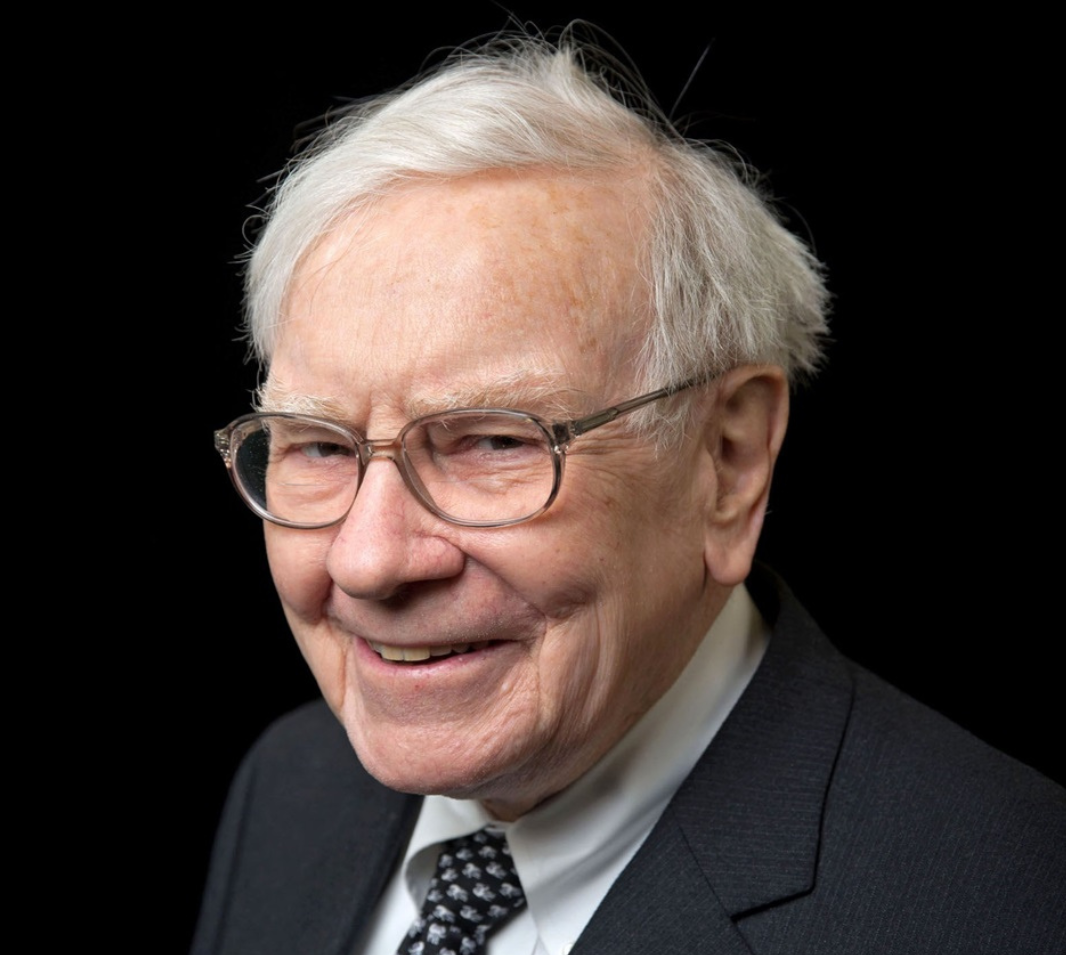
Warren Buffett
Chairman and CEO of Berkshire Hathaway and widely regarded as the greatest investor of all time, having compounded capital at approximately 20% annually over six decades to build one of the largest fortunes in history. His investment philosophy, shaped by Benjamin Graham's margin-of-safety framework and Charlie Munger's emphasis on business quality, centers on buying wonderful businesses with durable competitive moats — strong brand recognition, pricing power, network effects, or structural cost advantages — at sensible prices, and holding them indefinitely as earnings compound. Buffett evaluates businesses through the lens of owner earnings, normalized free cash flow, and long-term return on invested capital — metrics that reveal the true economic engine beneath reported financials and separate businesses that genuinely create value from those that merely appear to. Known for his extreme patience, intellectual honesty, and refusal to act outside his circle of competence, Buffett has demonstrated across multiple market cycles that disciplined business analysis and long-term conviction outperform frequent trading and macro forecasting. His annual letters to Berkshire Hathaway shareholders — compiled and annotated in The Essays of Warren Buffett edited by Lawrence Cunningham — are widely considered the most valuable free educational resource in investing and essential reading for any serious student of markets.
Videos
High returns, no receivables — the Buffett definition of a great business
▶ 5m 22sBuffett defines a great business simply: high return on tangible capital. Car dealerships work because you floor-plan inventory, do $100M+ in volume per location, and tie up almost no capital. Banks, by contrast, were extraordinary when leverage rules were loose but are now merely good businesses — regulators force them to hold more net worth per dollar of assets, compressing returns on equity. The bigger lesson: capital efficiency matters as much as earnings power, and even a great business becomes a bad investment if you overpay.
"A good business is one that earns a high rate of return on tangible assets. Very simple. The very best businesses earn a high rate and grow — but even ones that don't grow can be fine investments if you don't pay too much."
The zone of reasonableness: Buffett's framework for reading broad market valuation
▶ 5m 16sAsked about overall market valuation, Buffett explains his "zone of reasonableness" concept: stocks almost never trade at a precise fair value, but spend most of their time within a range where buying good businesses at reasonable prices still works. He's only felt compelled to speak out publicly about five times in his career — the most recent being his October 2008 New York Times op-ed saying stocks were cheap. He uses total market cap to GDP as a rough gauge, not a precise formula. Stocks outside that range — either dramatically expensive or clearly cheap — are rare events worth acting on.
"There've only been about five times in my life I've actually spoken out publicly to say the market was outside the range — the most recent being October 2008, when I said stocks were cheap."
The missed fax: the night one phone call could have changed the Lehman collapse
▶ 3m 8sBuffett tells the story of the Lehman weekend in September 2008. Barclays wanted to buy Lehman but needed shareholder approval — at least 30 days. CEO Bob Diamond called Buffett in Edmonton asking him to guarantee Lehman's contracts during that window, so Buffett said "fax me the terms and I'll respond by midnight." He came back to no fax — the hotel didn't have one. He gave up and slept. Ten months later he discovered the voicemail had been sitting unheard on his phone the whole time. It illustrates how chaotic and contingent the 2008 crisis actually was — a missed fax may have changed history.
"So if you really want to know the story of why Lehman failed — next time, send smoke signals to me if you have anything important to say."
Inside 2008: AIG rescue, the fog of war, and why macro never changes how Berkshire invests
▶ 8m 45sBuffett discusses the AIG crisis: he was approached the same weekend to value AIG's property/casualty subsidiaries, concluded it was "a mess of spaghetti," and told them not to waste time on him. His core judgment: AIG would have been bankrupt within 48 hours without the Fed's $85B injection, regardless of whether the terms were fair. The broader lesson is how chaotic real-time crisis decision-making is — "the fog of war." And yet none of it changes how Berkshire operates: in 55 years he and Munger have never adjusted decisions based on who's in power, where interest rates are going, or political gridlock in Washington.
"Charlie and I have been making decisions together for 55 years. We have never made a decision differently because of who's in power, what's happening with interest rates, or what's going on in Washington. You don't give up what you know how to do for opinions you can't verify."
America's marvelous machine: why 2% growth is more extraordinary than it sounds
▶ 4m 47sResponding to a JPMorgan question about slow post-crisis growth, Buffett pushes back on the pessimism. Across Berkshire's 70+ businesses he's seen steady, uninterrupted improvement since 2009 — no double-dips, no sharp deceleration. His mathematical case: 2% real GDP growth minus 1% population growth = 1% real per capita growth. Over one generation that's a 20%+ per capita gain in real income. Real GDP per capita is ~$54,000 — a 20% gain is $10,000 more per person. "That's enough to eliminate all poverty." The system that has unleashed human potential since 1776 is still working, even if the pace feels disappointing.
"In my lifetime, real GDP per capita in the United States has increased six-fold. One person's lifetime. It isn't because we're smarter or we work harder — it's because we have a system that unleashes human potential."
Dexter Shoe and stocks going down: recognizing bad businesses and buying weakness
▶ 5m 48sJenny Johnson asks when to give up on an investment. Buffett's signal: good management producing bad results — that tells you it's the business, not the people. He describes buying Dexter Shoe in the early 1990s for $400M in Berkshire stock, watching it fail immediately from foreign competition, and seeing it go to zero. Worse: that stock is now worth ~$5 billion. But a follow-up question reveals his attitude toward stocks going down in general — he gets euphoric. The stock doesn't know you own it, doesn't care what you paid. Stocks going down means you can buy more of a business you understand for less money — exactly like getting a grocery item cheaper than yesterday.
"I get euphoric when stocks go down. The stock doesn't even know that you own it. You are nothing to the stock. The only question every day is: can I get more for my money somewhere else?"
Homebuilding lags and the no-brainer 30-year mortgage argument
▶ 4m 3sThe final audience question asks about lagging homebuilding despite low rates. Buffett says it's surprised him — autos have recovered to 17M units per year while housing has trailed. His explanation: household formation collapsed during the recession as people moved in with parents and in-laws, but the pent-up demand will eventually express itself ("I have a lot of faith in hormones"). He closes with a memorable argument: the 30-year fixed mortgage is one of the most asymmetric instruments ever created — if rates drop you refinance, if they rise you keep the deal. "I can't get that one-sided an instrument at Berkshire Hathaway."
"A 30-year mortgage — if rates go lower, you refinance. If they go higher, you keep it. You've got a 30-minute instrument if you're wrong and a 30-year instrument if you're right. I can't get that deal at Berkshire."
54 years of decisions with no economic forecasts
▶ 4m 5sBuffett opens by explaining the foundation of his approach: he and Munger have never in 54 years made a business or investment decision based on an economic prediction. He monitors operating data from Berkshire businesses weekly, but uses it only to understand what is happening now, not to forecast the future. Whether buying stocks or companies outright, the intended holding period is forever, so short-term economic signals are noise. Price relative to long-term business value is the only variable that matters.
"We've never said yes to something because we thought the economy was gonna do well in the next year or two years, and we've never said no to anything because we were right in the middle of a panic — even if the price was right."
How much cash to hold — and why Apple is like a farm
▶ 4m 2sOn individual cash allocation: Buffett says the right amount depends on personal circumstances, but someone with a paid-off home and a diversified portfolio needs very little. On Apple: he explains why he does not follow it closely. It is a long-term investment, like owning a farm — you do not visit every week to see how tall the corn is. The crop yield analogy runs deep: a farm that produced 35 bushels per acre a century ago now produces 200. Good businesses compound the same way, and daily fluctuations are completely irrelevant to the long-term owner.
"It doesn't grow faster if I go and stare at it. I can't cheer for it — and I know there's going to be some years when prices are gonna be good, prices aren't gonna be good."
Buybacks: Berkshire's discipline and why government shouldn't set dividend policy
▶ 4m 28sBuffett explains Berkshire's buyback philosophy: they repurchase only when they believe the stock trades below intrinsic value and only after all business capital needs are met. He defends buybacks as economically equivalent to dividends — both are ways of returning excess capital to owners. He compares buying undervalued stock to buying out a business partner at a steep discount. He pushes back on Schumer and Sanders proposals to have government legislate when and how companies can return cash, arguing that directing dividend policy crosses a line the government should not cross.
"If you and I own a McDonald's franchise together and it's worth a million dollars, and you come to me and say I'll sell out for four hundred thousand — I'll buy you out."
What Buffett looks for in a president — weapons of mass destruction as the defining filter
▶ 4m 10sAsked about the 2020 election, Buffett says his primary criterion for a president is that they wake up every morning fully conscious that weapons of mass destruction — nuclear, chemical, biological, and now cyber — represent the existential threat to the country. Everything else is secondary. His second criterion is a president who holds two simultaneous economic objectives: growing the golden-egg-laying machine and ensuring that no one is left behind as GDP per capita rises. He draws on the Einstein quote that the atom bomb changed everything in the world except how men think.
"I want a president that wakes up every morning and realizes that the greatest threat to a country — which has got all kinds of things going for it — is weapons of mass destruction."
Kraft Heinz, brand power, and the Amazon retail revolution
▶ 4m 28sBuffett acknowledges that Berkshire paid too much for the Kraft side of Kraft Heinz — it is one of his largest admitted mistakes. He frames it in a broader structural shift: the balance of power between brands and retailers has been moving toward retailers for decades, and Amazon has accelerated that shift dramatically. Even Gillette, a brand he long considered impregnable, has lost position. He admires Bezos — met him 20 years earlier and recognized something special — but says Amazon was always outside the circle of businesses he could evaluate with confidence.
"There's always been a struggle between the retailer and brands... and the retailer's net, it has been moving in their direction — particularly, I think, because of the Amazon revolution."
Federal debt, income inequality, and why Buffett prefers the EITC over a minimum wage
▶ 4m 48sBuffett notes that running a 5% deficit during a strong economy is unprecedented, but it doesn't change what he does. On income inequality: as the economy specializes, market-valued skills command ever-larger premiums while people whose talents are unrelated to what the market currently rewards fall behind — not through failure of character, but through a mismatch with an increasingly narrow market. His preferred fix is an expanded Earned Income Tax Credit, paid monthly rather than annually, which puts money in working people's pockets without distorting the market system the way a minimum wage increase would.
"They just need more cash — they don't need a higher wage, they need more cash in their pocket."
Haven healthcare — taking on a $3.4 trillion industry
▶ 5m 1sBuffett discusses the healthcare initiative launched with Amazon and JPMorgan, now named Haven. The challenge is formidable: a $3.4 trillion industry where nearly everyone agrees the system needs adjustment, but no one wants to reform their particular piece. The key structural advantage is that the three founding CEOs can make things happen in large organizations without internal bureaucracy or political friction. Buffett frames the problem clearly: the US spends 18% of GDP on healthcare versus other developed countries spending far less while delivering comparable outcomes — that gap is an economic competitiveness problem, not just a cost problem.
"You've got a three-point-four trillion dollar industry — which is as much as the federal government raises every year — that basically feels pretty good about the system."
Reading habits, the 2008 GE investment, and Berkshire's capital engine
▶ 5m 16sBuffett explains his reading habit as an 88-year compounding advantage: read widely, remember the lines that clarify difficult problems, and apply them decades later. On GE: he deployed capital actively in late 2008 but was early — he used his powder before the March 2009 bottom. He then walks through Berkshire's structural capital efficiency: businesses like See's Candy that cannot be expanded geographically still throw off cash, which Berkshire redeploys into BNSF or utilities without incurring the tax leakage that individual investors face when they sell one asset to buy another.
"If you just remember these things and apply for 88 years — you don't know what happened yesterday, but you remember the old stuff."
Succession — Ajit, Gregg, Todd, Ted, and attracting the right Berkshire shareholders
▶ 6m 54sBuffett distinguishes his four successors precisely: Ajit Jain runs Berkshire's insurance operations (hundreds of billions in assets); Greg Abel runs all non-insurance businesses ($150B in revenue); Todd Combs and Ted Weschler each manage approximately $13 billion in equities with complete independence. None of them coordinate across domains. He also explains Berkshire's shareholder cultivation strategy: just as Costco's membership fee filters out drop-in customers, Berkshire's letters and communications are designed to attract long-term, aligned owners and make short-term traders self-select out.
"When you have a public company, you can't control who comes in — so by my actions and my communications and everything, I want to attract the people from the public market that I want, and I want to keep the others away."
Climate change, cyber risk, and Elon Musk
▶ 5m 13sOn climate change and insurance: because Berkshire writes one-year policies, it can reprice annually as conditions evolve — unlike long-term care or life insurance. The counterintuitive fact is that catastrophe insurance rates have actually fallen since 2005, which is why Berkshire largely exited the cat business — the risk-adjusted price is wrong, not fear of climate. On cyber: Buffett sees it as the most unpredictable existential risk, especially for Berkshire railroads hauling hazardous materials. He notes briefly that Elon Musk's communication style has room for improvement, while acknowledging his remarkable abilities.
"We aren't out of the cat business because of climate change — we're out because the prices aren't right."
US and China: competitors not enemies in the nuclear age
▶ 4m 16sBuffett declines to comment on the specific trade war politics but speaks directly to the structural US-China relationship. He argues both countries are destined to remain superpowers well beyond his grandchildren's lives and competition between them is inevitable and largely healthy. But the nuclear age means competition must never tip into something resembling war — the lesson of World War I is that chance incidents can escalate far beyond anyone's intention. His core point: a world in which both the US and China prosper is the best world for both, and leaders in powerful countries must keep that recognition front of mind.
"You can be competitors without being enemies — and that's what all powerful nations have to realize over time."
Chinese acquisitions, the trade deficit, and China's economic miracle
▶ 6m 1sBuffett says he is open to acquisitions in China but finds the US easier because he knows the accounting, law, and business culture far better — there is a hurdle, even if not an insurmountable one. On trade deficits: persistent large imbalances concern him because you are effectively shipping pieces of paper while the other country ships real goods, and eventually those paper-holders will want to exchange them for something real. He closes with a sweeping observation: US real GDP per capita has grown sixfold since he was born, which his parents would not have believed — and China's transformation since 1949 is an even more compressed and extraordinary version of the same story.
"China's had a hurricane at their back — and in the recent decades, in a good way."