
Clement Ang
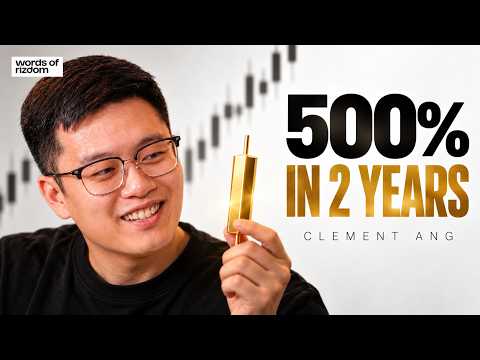
Clement Ang is a Hong Kong-based portfolio manager at SilverCape Investments and a two-time competitor in the US Investing Championship's million-dollar division, posting a combined +522%. Raised in Singapore and educated at Nanyang Technological University, he began trading in late 2019 as a second-year economics and finance student after his mother introduced him to the stock market, and traded through the COVID crash, the 2020–21 bull market, and the 2022 bear. A 60% drawdown in early 2023, driven by shorting Tesla on tilt, forced him to rebuild his process around the work of Kristjan Qullamaggie, William O'Neil, Mark Minervini, and Oliver Kell. He now trades Stage 2 breakouts and pullbacks, reads market environment before selecting stocks, and scales risk to his equity curve.
Origin Story: A Student, a First Stock, and Four Cycles
▶ 2m 17sClement Ang began trading in late 2019 as a second-year economics and finance student in Singapore, after his mother introduced him to the stock market and had him buy his first stock. He traded through the COVID crash of 2020, the 2020–21 bull market, the 2022 bear market, and the cycle that followed, and says the experience changed him financially and emotionally. The lesson he draws is that trading has to be run as a business: know your numbers, know your own statistics, and know yourself. The other requirement is passion, because without it a trader burns out and quits precisely when conditions get hard.
"You have to treat it as a business. Look at the numbers, know your own trading stats, know yourself."
Why He Entered the US Investing Championship
▶ 2m 8sBy 2024 — his fifth or sixth year trading — Ang felt he could post a big return when market conditions were good, and he wanted a way to keep himself accountable. Trading behind closed doors made it easy to break his own rules when nobody was watching; sending brokerage statements to the US Investing Championship organizer put his monthly standings in public view and created pressure to follow his written plan. He credits the back-to-back results partly to maturing as a trader and partly to a favorable market environment.
"If I'm trading behind closed doors and no one knows what I'm doing, I could very easily decide I can afford to break this rule."
Death by a Thousand Cuts in the 2022 Downtrend
▶ 1m 42sAng entered 2022 with no framework for market cycles and did not recognise that the market had topped as rates rose and distribution set in. He kept buying long in a downtrend — an energy stock, a biotech, any name that looked like it was resisting the decline — and each one was eventually dragged down with the index. The result was a year of stop-out after stop-out: financial capital eroded slowly and mental capital drained faster, leaving him burnt out by the end of 2022. It is the clearest illustration in the interview of why market environment has to be the first filter, not an afterthought.
"I was basically experiencing a death by a thousand cuts. Every period I put on, I set my stop loss, I stopped out."
Short Selling, a Newsletter, and the Tesla Blowup
▶ 2m 47sSearching for a way to make money in the 2022 downtrend, Ang read Short Selling with the O'Neil Disciples by Gil Morales and Chris Kacher and subscribed to Morales's newsletter, now the Owl Report. He made enough on the short side in the fourth quarter to recover some ground, and short selling felt intoxicating when it worked — which set up the disaster that followed. In early 2023, unaware the market had bottomed, he shorted Tesla into a rising trend, was stopped out, then re-shorted with double the size. The accumulated frustration tipped him into trading on tilt: he dropped to a five-minute chart and shorted every minor turn at full size, drawing his account down roughly 60% in one to two weeks.
"Instead of looking at the daily chart, I zoomed in on a five-minute... I was full-porting a short on Tesla on every single minor turn."
The Poolside Moment and the Model Book That Rebuilt Him
▶ 2m 40sAfter the 60% drawdown Ang sat by his condo pool unable to tell his mother-in-law what had happened, stopped trading for a few weeks, and seriously considered quitting to work a normal job. What pulled him back was the realisation that he did not want to work for someone else and the example of Kristjan Qullamaggie: study how the biggest winners move, build a model book, and review it until the patterns become obvious. That was the turning point from trading a vague strategy to running trading as a business, with a written risk-management plan, an entry model, a trade-management plan, and quarterly and annual reviews.
"You want to make money in the markets, you have to study how the biggest winners move. Make your model book."
The Interview That Only Made Sense Two Years Later
▶ 1m 51sAng first watched Ryan Pierpont's TraderLion interview in 2021, when a cumulative return above 1,000% sounded impossible, and dismissed it with healthy skepticism. When markets got hard he revisited it and the ideas suddenly made sense; from there he reread Market Wizards, found William O'Neil and David Ryan, discovered Investor's Business Daily, and moved on to Mark Minervini and the wider TraderLion catalogue. His approach is not original, he says — he takes bits and pieces from every trader he studies and assembles what fits his personality.
"My first thought back then was this is crazy. This is impossible."
Make It Your Own: Impatience and the 28-ADR Trim
▶ 1m 37sAng argues that the personal details around a strategy matter more than the strategy itself, because every trader's psychological makeup is different. He is naturally impatient and cannot sit through months of position-trade pullbacks, so he found a middle ground in Mario's approach of taking a partial at 2.5 ADRs from entry; in trending environments Ang now takes a third of the position off at 28 ADRs of unrealised gain. Everyone buys breakouts and pullbacks, he says — how you apply the method to your own temperament is the real edge.
"Everyone's doing the same thing. It's just how you apply it and make it your own. That's the real edge."
Know Your Numbers: Win Rate, Average Gain, Hold Time
▶ 1m 21sThrough his boom-and-bust years Ang did not track his results. In 2024, after absorbing Minervini's insistence that you must know the numbers behind your own system, he began reviewing his trading religiously every month and every year. He tracks win rate, average gain and average loss, largest win and largest loss, and how long he holds winners versus losers. The point is not record-keeping for its own sake: each month he uses the stats to work out what he needs to adjust to stay net profitable.
"Minervini always says you have to know the numbers behind your own trading system."
Market Environment Is the First Filter
▶ 3m 28sNewer traders prioritise the setup over the environment, Ang says; the longer you trade and the more winners you study against an index chart, the clearer it becomes that the market sets the odds. When the NASDAQ is above a rising 10-day and 20-day moving average, breakouts follow through more easily; when the index is below all its relevant moving averages, he treats almost any breakout as likely to fail. That makes market environment the first filter on how much risk he is willing to take, before he looks at a single stock.
"When the index is trending below all the relevant moving averages, you can almost guarantee that any breakout you find will fail."
Anatomy of the April 2025 Bottom
▶ 4m 1sAng walks through the April 2025 Liberation Day low as a case study in reading the market rather than predicting it. The first signal was technical: leaders began breaking their 20-day exponential moving averages in February, so short-term momentum was gone. Through the selloff he screened for relative strength and found growth names holding above their moving averages while the NASDAQ sat below all of its own, and sentiment on X was universally bearish. The turn came on a Monday gap-down that immediately snapped back — an undercut and rally — with the NASDAQ testing its February 2021 breakout level, which turned into support, and the strongest leaders breaking out first. No single indicator called the bottom; it was the sum of the evidence.
"There's no one indicator that will tell you the market has bottomed. It's more like the sum of the evidence, putting the puzzles together."
Don't Trade Other People's Ideas
▶ 6m 18sAng has relationships with many of the traders he once studied, but he rarely acts on their ideas: if a name does not fit his own criteria, he will not trade it, because he will not have the conviction to hold it through a pullback. Taking someone else's conviction creates the worst outcomes — exiting early, or blaming the other person when the trade stops out — and he insists that treating trading as a business means taking full accountability for every decision. Asked how he found what fit him, he describes an experimental phase that produced his long-side setup: a Stage 2 uptrend, a pullback, a wedge pop above the 10- and 20-day exponential moving averages, then a tight mini launch pad.
"If I trade their idea, I don't have the conviction to hold on to it."
One Setup, Three Dialects — and the Risk That Fits You
▶ 2m 26sAng noticed that the traders he studied were all describing the same setup in different language: Oliver Kell's wedge pop and base, Minervini's VCP, and Qullamaggie's move that tightens as the 10- and 20-day catch up, forms a higher low, and breaks out. He tested those ideas with real money until he found his own version. The same experimental logic applied to risk: the standard 1% per trade sounded sensible, but after 10 or 30 consecutive losses the cuts compound into a serious drawdown; he found that 3–5% builds more failure into the system and suits him, and after a stressful Q1 2025 at 0.5–1% he moved to 3–5% from Q2 onward.
"They're all actually the same concept, just set differently."
Progressive Exposure Is an Art, Not a Science
▶ 1m 45sWhen conditions improve, Ang steps on the gas rather than staying inside a fixed risk band: from 100% cash he will start at about 2%, and if the environment and the balance of long versus short setups keep improving he will ramp toward 5% and end up fully invested. He is deliberately unsystematic about it, because mechanical ramping risks putting your largest risk on just as the market is about to stress-test you and pull back. Getting that timing right comes down to experience and judgment — reading the pieces of the puzzle early enough to take the bet that conditions have turned.
"Progressive exposure is more of an art than a science... by the time the market really has turned, you're putting your biggest risk when the market is about to stress-test you and pull back."
The Ethereum Trade: Four Layers of Conviction
▶ 2m 34sAng's A+ trades are the only ones where he will go below his normal risk band — about 1% initially — and the Ethereum trade of June–August 2025 is his example. Price action was constructive, but the edge came from stacking independent evidence: commitment-of-traders data showed large speculators at maximum short, a short position that would have to be covered; Bitcoin was setting up in the same way; the related crypto group was confirming; and the broader market had bottomed in April and was in a strong uptrend. Once the trade worked he parlayed the profits into a buffer and risked that buffer on the same idea rather than taking it off the table.
"If Ethereum does break out from here... you'd see a lot of short covering, which would add rocket fuel for that upside."
Fixed vs Dynamic Sizing: No Black-and-White Answer
▶ 3m 50sThe host frames the debate between the 1%-per-trade rule and aggressive sizing on A+ setups; Ang says the top traders he speaks with, Christian Flanders among them, do use dynamic sizing, but there is no universally correct answer. Fixed risk builds failure into the system because you always lose a predictable amount; dynamic sizing lets you press when everything aligns, but it also means some A+ setups fail and you must absorb the loss without going on tilt or revenge trading. Even with fixed risk, Mario produces outlier winners, so the decision comes back to what each trader can psychologically withstand.
"Can you withstand that psychological pressure when it doesn't work on you? Can you accept that loss?"
Find Your Risk Ceiling — and Risk Only Your Cushion
▶ 3m 11sAng describes how he previously found his risk ceiling by experiment: 2% per trade felt wrong, and 1% was where he was comfortable. When a trade works and sets up again, he will risk part of the unrealised profit on that same idea rather than adding fresh capital at risk. He thinks about the equity curve in order of operations: preserve capital first, then aim for consistent profitability, and only pursue superior returns once you have built a cushion — because a trader who starts the year in a hole has nothing to risk from and has to spend the good environment digging out. Right now, with the market trending lower and his own year only slightly green, he is treading water and staying patient.
"Number one, you have to preserve your capital. Once you're able to do that, number two, you try and aim for consistent profitability."
Survive Before You Thrive
▶ 2m 17sThe host suggests new traders chase outsized returns before they have learned to survive; Ang agrees this is a normal stage of the journey and warns that a year or two of reading books and placing trades will not be enough. Even with back-to-back championship results he still has imposter syndrome, and every market cycle presents a different challenge, so the work never stops. His rule is to be a little bit chicken when the environment does not fit his strategy, because spending a good market digging out of a hole is the worst outcome available.
"Be a little bit chicken and stay conservative, because you don't want to put yourself in a position where you've dug yourself a big hole."
Training Your Eyes on the 2023 Winners
▶ 2m 59sTo learn market environment, Ang adopted Qullamaggie's exercise wholesale: chart every big winner of 2023 and ask where he would have bought, where he would have placed his stop, how he would have managed the trade, and whether the stock respected its 10-day or 20-day moving average on the way out. He repeated it until the patterns became obvious, then overlaid the index on his entries and exits and saw that when the QQQ was extended, breakouts tended to fail — so he became more selective and bought pullbacks instead of breakouts. Rereading the first 100 charts in O'Neil's How to Make Money in Stocks produced the aha moment: the biggest winners come after market corrections, which made him more patient in the current decline.
"The biggest opportunities, the biggest winners, happen after market corrections. Why didn't I get it until now?"
Cut Size in Half When the Market Says You're Wrong
▶ 1m 57sAt a dinner in Hong Kong, Christian Flanders gave Ang the rule that reshaped his risk management: if you are getting stopped out on every trade, the market is telling you that you are wrong or the environment is wrong — so cut your size in half, not double it. Ang had done the opposite with Tesla, doubling size after a stop-out; the correct response is to shrink until the equity curve barely moves, even if it feels humiliating to be stopped out on one share. He also sets a monthly loss floor: once the account is down around 5% for the month, he takes a few days off and returns with minuscule size until he regains traction, which keeps drawdowns small enough to recover quickly.
"If you're getting stopped out on all your trades, it's the market telling you something. You want to slash your size in half."
How to Earn Your Size Back
▶ 2m 31sAng admits there is no clean answer to when you should restore normal size after cutting it, and describes what he actually did in 2025. After a 50% May he began selling winners too early — he sold Robinhood into strength expecting a pullback that never came while the stock doubled — then gave back part of the peak and cut size. Through June he stayed selective and waited for A+ setups; a gold and silver consolidation breakout justified a normal 0.3% risk, and when losses resumed later in the month he cut again and waited until Bitcoin and Ethereum set up. The lesson is that he did not rebuild size gradually on mediocre trades: he waited for the setup strong enough to take normal risk immediately.
"I was cutting my size down until I saw what I would consider an A+ setup."
When 0.3% Becomes a Month's Salary
▶ 2m 36sAng says risk limits are still felt in dollars, not percentages: after an 80% year in 2024 he added capital, and a normal 0.3% risk suddenly equalled a month's salary, so he instinctively sized down while he adjusted. Moving to a fund role with a much larger AUM multiplied the effect — a losing streak felt like giving back an entire year's return — and the adjustment took time. His practical fix is to turn the account balance off, focus on the equity curve and the chart in front of him, and manage the trade rather than the money.
"If I stop out, that's the equivalent of my one month salary. And that hurt."
The Mental Barrier Is the Position Size
▶ 3m 31sAng argues that the barrier to trading larger size is psychological and shaped by upbringing: someone raised in scarcity feels money differently from someone raised with plenty, so the work of adjusting to a new account size is internal, not analytical. He believes people can break through those limits, but it takes determination and honest self-reflection, and the adjustment period is different for everyone. He also accepts that trading a large account is a reality many people imagine without understanding — and quotes the old line that everyone eventually gets what they want from the market.
"Everyone gets what they want in the market."
You Can Do Everything Right and Lose
▶ 2m 46sThe host points out that trading breaks the reward system most people grow up with: you can do everything right and still lose money. Ang connects this to an Asian education system built around a single right answer — he admits to once flipping to the answer key in a school workbook because he was afraid of being wrong — and says markets offer no answer key. Trading is probabilistic and there is always an element of luck; the job is not to eliminate uncertainty but to position yourself so that luck can find you.
"You can do everything right and lose money, which is completely the opposite of what we're told."
The Mechanical Screen: Stage 2, RS, and Under Four ATRs
▶ 3m 42sAng separates the mechanical part of his process from the discretionary part. His screen looks for Stage 2 uptrends: price above a rising 50-day and 200-day moving average, ideally above the 20-day exponential moving average where he engages; market environment must be favorable or the win rate collapses. He then demands relative strength — the RS line above its own 21-day moving average, or simply a stock moving sideways or up while the market falls, as Fastly did on its earnings gap while the market was selling off — followed by a volatility contraction on low volume that shows supply has dried up. Finally he checks extension: he prefers the stock less than four ATRs from its 50-day, because beyond that the meat is off the bone.
"When there's low volume as a stock is consolidating, there's not a lot of supply... it just takes a little bit of demand to push the price higher."
Three Watchlists and a Breakdown List
▶ 3m 25sAng runs his universe through DeepVue, using preset scans plus custom ones — for example, when the market is down 2% for the week, he scans for stocks up 10%. During the week he moves names through three lists: a wide list covering the universe for the next couple of weeks, an almost-ready list for stocks showing relative strength and tightening price and volume, and an execution list of his top five to ten names for the session. A fourth list collects breakdowns: he does not scan for shorts, he lets the market tell him when to look, demoting stocks that lose the 20-day exponential moving average onto the short candidates list. He repeats the process every day because it builds a feel for the quality and quantity of setups on both sides.
"I don't exactly scan for shorts. I let the market tell me it's time to look for shorts."
Missing a Monster Move
▶ 3m 43sAng says he no longer feels much FOMO, but he still beats himself up when a move is inside his strategy and he fails to execute — the recent example was watching Micron gap down toward its 10-day and rip higher without buying. When that happens he reviews the failure in his process and his mental state, including anything outside trading that may have cost him focus. He completely missed Sandisk's monster run, twice, and has learned to treat the market as an unlimited stream of opportunities: instead of chasing, he works on finding a way into a leading theme through a pullback to a moving average, because leaders tend to go further than expected.
"In the stock market, it's an unlimited stream of opportunities... there will always be another opportunity around the corner."
1,000 Trades, 500 Mistakes
▶ 3m 49sAng reviewed more than a thousand trades from 2025 month by month rather than in one year-end binge, tagging each one as either a legitimate setup or a mistake — re-entering after a stop-out, oversizing relative to his plan, or taking a non-setup out of FOMO. Reading Steven Goldstein's work on behavioral leakages gave him the framing: you can improve profit by sharpening offense (better setups) or defense (cutting mistakes), and he found roughly 500 trades that were pure excess fat. He illustrates the pattern with June, when he passed on Coinbase and Circle, watched his friends profit, and then overtraded the following week to compensate — all non-setups that sent him into another losing streak.
"There are 500 trades that was excess fat. There were overtrades, there were setups I shouldn't take or there were non-setups."
Trade Better, Not Trade Less
▶ 1m 25sWhen Ang calculated the P&L lost to those mistakes, he realised 2025 could have been a monster year, and he turned that number into a mandate for 2026: trade the process better and be more patient with himself. He pushes back on the common advice to simply trade less — less is only right if the trades you cut are outside your strategy. The better formulation, he says, is to trade better: fewer low-quality trades, more faithful execution of the process you already have.
"It's more appropriate to say trade better, trade your process better."
Managing Other People's Money
▶ 3m 30sMoving from his own account to a fund role with a much larger AUM has been harder psychologically than he expected: a flat January felt terrible because the dollar amount given back was equivalent to two managing-director salaries. The deeper problem was the thought that it was not his money, which led to a period of trading scared — he would set a stop, watch the trade move against him without hitting it, and exit early, only for the stock to rip back and work. He fixed it by insisting that once the stop is in he honours it, because the market — not his own anxiety — is what tells him he is wrong, and by using weekends away from the screen to regain perspective.
"There was a period of time where I was trading very scared... I was not accepting the risk on that trade."
The Hong Kong Routine
▶ 3m 49sAng treats routine as non-negotiable: when he strays from it, he stops trading well. His day is built around his son — wake at 8, school run at 8:30, then two hours in a cafe from 9 to 11 going through watchlists and writing the plan for the night session, lunch and an hour or two of study or model-book work, afternoon classes and the playground, a workout, dinner and family time. Half an hour before the US open he is at his desk, trades until midnight or 1 a.m., sets his stops and sleeps, aiming for at least seven hours because less than that throws off his focus. The consistency outside the screen, he says, is what protects the consistency on it.
"Whenever I stray away from routine, I definitely don't trade well."
Final Words: Survive Now So You Can Thrive Later
▶ 3m 51sIn his closing message Ang reminds viewers that this is his seventh year and he feels like he has only just started. Every trader will have highs and lows, and it is the lows that decide who lasts — so the work is to find a why strong enough to carry you through them. He urges patience and optimism, and repeats his central rule for the current environment: preserve your financial and mental capital, because you survive now so that you can thrive later.
"You survive now so that you can thrive later."